Admitting to mistakes and tolerating dissent are two important qualities that distinguish good political leaders from those who aren't. These two traits are positively not trademarks of Dr. Beyene Petros' leadership styles. We shared with our readers a few weeks ago about Dr. Beyene's feeble attempt to rehabilitate his political image after his gambit to remain in Meles Zenawi’s good graces took an unfavorable turn.
In this communication, we share two press releases in Amharic, one from the group led by Dr. Beyene and another, a response by the Democratic Organization of Hadiya National Unity (DOHNU), an organization that was created a few months ago after Dr. Beyene illegally claimed the Hadiya Nation Democratic Organization (HNDO) to himself through undemocratic means. Unfortunately, the tone and content of this press release of his evokes memories of the horrendous days of the Dergue regime!
Unwittingly or not, it is clear that Dr. Beyene is trying to pit the people of Hadiya against each other. We are truly saddened by his continued abuse of the good name of the Hadiya people for his selfish political ends. This press release of Dr. Beyene unmasks to the public the true nature of the leader of the group that has misappropriated the good name of the HNDO. His tirade has gone beyond insulting his old colleagues within HNDO. It calls the Ethiopian Diaspora "traitors", despite his continued effort to coax the Diaspora community for financial support.
It is only about 6 years ago that the agents of the ruling TPLF/EPRDF and its army atrociously and vengefully terrorized the law-abiding Ethiopians in the Hadiya zone for no reason other than voting for an opposition HNDO in an election organized by the TPLF/EPRDF itself. As we have reported previously, HNDO, an organization that epitomized peaceful and legal struggle against an undemocratic and unlawful regime in Ethiopia, has been weakened and divided by the vengeful actions of Dr. Beyene Petros since 2001.
By this action, Dr. Beyene has perpetrated yet another horrid enormity on the struggle of the peoples of Ethiopia for representation, democracy and the rule of law. The once vibrant and flagship organization in the South, the Southern Ethiopian People’s Democratic Organization (SEPDC) has been reduced to a name he swears by when he is challenged by his old SEPDC colleagues, and it serves only as Dr. Beyene’s ticket into the gates of Western Embassies.
After Dr. Beyene found himself in a precarious political situation with the Ethiopian people after the 2005 elections, instead of looking inward and examining his short comings as a leader, Dr. Beyene has raised the level of his vindictiveness against any group that disagrees with him. In a political career that spans a decade and a half, Dr. Beyene has sadly come to symbolize mediocrity and obsession for holding the chairmanship of multiple organizations, even obsolete ones.
Many Ethiopians, including those who faithfully stood by Dr. Beyene and supported him for more than a decade are raising questions about his credibility and legitimacy as an opposition politician, and the public has lost confidence on him. It is all too clear to us that his intolerrance of dissent and his unwillingness to admit to mistakes have become hallmarks of his leadership tenure. In spite of this reality, Dr. Beyene continues his vengeful actions against his opponents and critics using all the resources and means at his disposal.
We, former colleagues of Dr. Beyene, have given him the best chance any political ally of his can give him to correct his mistakes and to submit himself to democratic principles, which he purportedly stands for, and to align himself with the Ethiopian people in their struggle against tyranny. But his responses have so far been dismissive and outright hostile. If he cares to listen, our advice to him once again is: learn to tolerate dissent in the organizations you lead and have the humility to admit to mistakes when you make them.

Monday, December 04, 2006


Sunday, December 03, 2006
The Festival of 1000 Stars
The 4th Festival of Music & Dance of the peoples of Southern Ethiopia will be held from 16th to 18th of December 2006 daily at the Football Pitch in Arba Minch. The festival is a free event sponsored by the Christensen Fund in association with Global Music Exchange. You can watch videos and listen to sounds from the Festival of 1000 Stars of December 2005 on YouTube here or on MySpace here.
Friday, December 01, 2006
Hebret on Somalia
This statement from the UEDF (Hebret) is the most incisive statement on the current situation in Somalia that I have seen from an Ethiopian political group. I believe the statement skillfully and responsibly expresses the views of the vast majority of Ethiopians on this issue. It is six pages long and it is worth your time to read it if you are fluent in Amharic. I wish they had an English version of it.
Sunday, November 26, 2006
Solution to the Quagmire in Somalia
By Fikru Helebo
Back in the summer months when I was trying to understand what was going on in Somalia after Mogadishu was taken over by radical Islamists, I started visiting some Somali web sites to read what Somalis were thinking about what is happening in their homeland. The sense I got was that many of them were willing to give the Islamists a chance. I posted a representative sample of their opinions along with my own comments here.
One of the opinion pieces I came across at that time was an article by Amina Mire, a cousin of the leader of the Islamists, Sheikh Hassan Dahir Aweys. In her article, the feminist Mire argues that what Somalis needed the most at this time is a sense of security in their own country and she was prepared to give the benefit of the doubt to the Islamists, even though she is convinced that Somali women will not fare any better under Islamic Sharia law.
In an email conversation I had with Mire after reading her article, she related to me that the central reason for the lack of political stability in Somalia in the last 16 years was Ethiopian interference in Somali affairs. She also seemed to attribute the ills of Somali society such as warlordism and the consumption of the mild narcotics khat (tchat) on Ethiopia. While I agreed with Mire that interference by the Meles regime was, indeed, one of the reasons for the political instability in Somalia today, I indicated to her that the premium that Somali society places on clan loyalty over and above everything else is the main culprit.
The regime in Addis Ababa has been using this weakness in Somali society to its advantage and, unfortunately, to the detriment of Somalia just as it has been using ethnic differences to divide and rule Ethiopians. Unfortunately, Amina Mire did not take kindly of my argument and she blasted me as being a proxy to the Ethiopian regime. Now that the Islamists have expanded their sphere of influence in Somalia in the last three months and they are gearing themselves to take on the Ethiopian-backed groups in Somalia, namely the Transitional Federal Government (TFG) based in Baidoa and the Puntland autonomous regional government, I wonder what Mire now thinks about the prospect for a secure Somalia with the radical Islamists, backed by Eritrea and a host of foreigners including jihadists, unwilling to compromise with the TFG.
The Addis Ababa regime also has not shown any willingness to compromise with the Islamists. It recently declared that the Islamists pose "a clear and present danger" to Ethiopia and that its military has finished preparations for war with the Islamists. Such declaration is uncalled for as there is no imminent threat of an attack on Ethiopian territory by the Islamists, at least not that I can detect. The talk of crushing the Islamists of the summer months has dissipated, but this declaration is still a provocative move and will not help to reduce the heightened tensions.
Meles has a proven track record of talking the talk but not walking the walk when dealing with his opponents. Therefore, all his talk about being committed to a peaceful resolution of the current Somali conflict should not be taken very seriously. If he wants to be taken seriously, especially by Somalis, Meles needs to start taking tangible steps to demonstrate that his regime is abandoning meddling in Somali affairs by genuinely seeking a broad-based solution to the quagmire in Somalia as outlined in this balanced presentation by Amb. David Shinn, a former high ranking US diplomat, in a remark before the Somali Institute for Peace and Justice in Minneapolis, Minnesota, USA on November 11, 2006.
Back in the summer months when I was trying to understand what was going on in Somalia after Mogadishu was taken over by radical Islamists, I started visiting some Somali web sites to read what Somalis were thinking about what is happening in their homeland. The sense I got was that many of them were willing to give the Islamists a chance. I posted a representative sample of their opinions along with my own comments here.
One of the opinion pieces I came across at that time was an article by Amina Mire, a cousin of the leader of the Islamists, Sheikh Hassan Dahir Aweys. In her article, the feminist Mire argues that what Somalis needed the most at this time is a sense of security in their own country and she was prepared to give the benefit of the doubt to the Islamists, even though she is convinced that Somali women will not fare any better under Islamic Sharia law.
In an email conversation I had with Mire after reading her article, she related to me that the central reason for the lack of political stability in Somalia in the last 16 years was Ethiopian interference in Somali affairs. She also seemed to attribute the ills of Somali society such as warlordism and the consumption of the mild narcotics khat (tchat) on Ethiopia. While I agreed with Mire that interference by the Meles regime was, indeed, one of the reasons for the political instability in Somalia today, I indicated to her that the premium that Somali society places on clan loyalty over and above everything else is the main culprit.
The regime in Addis Ababa has been using this weakness in Somali society to its advantage and, unfortunately, to the detriment of Somalia just as it has been using ethnic differences to divide and rule Ethiopians. Unfortunately, Amina Mire did not take kindly of my argument and she blasted me as being a proxy to the Ethiopian regime. Now that the Islamists have expanded their sphere of influence in Somalia in the last three months and they are gearing themselves to take on the Ethiopian-backed groups in Somalia, namely the Transitional Federal Government (TFG) based in Baidoa and the Puntland autonomous regional government, I wonder what Mire now thinks about the prospect for a secure Somalia with the radical Islamists, backed by Eritrea and a host of foreigners including jihadists, unwilling to compromise with the TFG.
The Addis Ababa regime also has not shown any willingness to compromise with the Islamists. It recently declared that the Islamists pose "a clear and present danger" to Ethiopia and that its military has finished preparations for war with the Islamists. Such declaration is uncalled for as there is no imminent threat of an attack on Ethiopian territory by the Islamists, at least not that I can detect. The talk of crushing the Islamists of the summer months has dissipated, but this declaration is still a provocative move and will not help to reduce the heightened tensions.
Meles has a proven track record of talking the talk but not walking the walk when dealing with his opponents. Therefore, all his talk about being committed to a peaceful resolution of the current Somali conflict should not be taken very seriously. If he wants to be taken seriously, especially by Somalis, Meles needs to start taking tangible steps to demonstrate that his regime is abandoning meddling in Somali affairs by genuinely seeking a broad-based solution to the quagmire in Somalia as outlined in this balanced presentation by Amb. David Shinn, a former high ranking US diplomat, in a remark before the Somali Institute for Peace and Justice in Minneapolis, Minnesota, USA on November 11, 2006.
Sunday, November 12, 2006
Virginians: Which candidate did you vote for?
I have placed a poll question on the right exclusively for Ethiopian Americans from the Commonwealth of Virginia. The contest between Jim Web and George Allen for US Senate was decided by fewer than 10,000 votes out of 2,370,900 votes cast. If you did vote in the election on Noverber 7th, I would like to know which candidate you voted for. Please take a few seconds to vote. The poll is open for one week. Respect for the honor code is appreciated. Thanks.
Saturday, November 11, 2006
Is Foreign Aid Working?
Here is an interesting debate on foreign aid between Hilary Benn, the British secretary of state for international development, and William Easterly, a critic of direct aid to recipient governments, such as Ethiopia, with no strings attached. I think Easterly makes a lot more sense than Benn. If donor governments are serious about reducing poverty in poor countries, the first and the best thing they should do is to stop their direct budget support to recipient governments. Easterly's argument for how success in foreign aid should be measured is also more persuasive.
Thursday, October 26, 2006
Delusion, Frivolity and Now Desperation
A group that is chaired by Dr. Beyene Petros and illegitimately calls itself the United Ethiopian Democratic Forces (UEDF) recently put out a press release entitled "On the Current political situation in Ethiopia". This statement smacks of political desperation and it is mainly designed to continue to make Dr. Beyene relevant in the eyes of the unsuspecting diplomatic community, which he is not. Dr. Beyene thinks he can continue to hoodwink the Ethiopian public through deceptions and manipulations in the name of the two organizations, the Hadiya Nation Democratic Organization (HNDO) and the Southern Ethiopian People's Democratic Coalition (SEPDC), that he has been secretly using to advance his personal ambitions for over a decade. Not anymore!
The statement by "UEDF" brings to public an internal political struggle within the HNDO that has remained in the dominion of the members and supporters of HNDO since the local elections of 2001 (detailed accounts of violations of democratic principles, intolerance of dissent and betrayal of our people's wishes by Dr. Beyene will be made available here in the future). The statement also condemns what it calls "shameful acts of the few others who are at the services of the ruling party and the few others who are trying to serve as conduits to the unrealistic agendas of some diaspora political movements".
The latter half of the above statement is directed at three members of the Federal Parliament and eleven members of the Regional Parliament that have supported the creation of the Democratic Organization of Hadiya National Unity (DOHNU), an organization which was created a few months ago after Dr. Beyene illegally and undemocratically usurped power from the General Assembly of the HNDO and facilitated a backdoor election and transfer of HNDO leadership to his lackeys in violation of the regulations and bylaws of the organization. The DOHNU has put out a press release [in Amharic] in response to the allegations made by Dr. Beyene in the name of "UEDF". Please find it here.
The statement by "UEDF" brings to public an internal political struggle within the HNDO that has remained in the dominion of the members and supporters of HNDO since the local elections of 2001 (detailed accounts of violations of democratic principles, intolerance of dissent and betrayal of our people's wishes by Dr. Beyene will be made available here in the future). The statement also condemns what it calls "shameful acts of the few others who are at the services of the ruling party and the few others who are trying to serve as conduits to the unrealistic agendas of some diaspora political movements".
The latter half of the above statement is directed at three members of the Federal Parliament and eleven members of the Regional Parliament that have supported the creation of the Democratic Organization of Hadiya National Unity (DOHNU), an organization which was created a few months ago after Dr. Beyene illegally and undemocratically usurped power from the General Assembly of the HNDO and facilitated a backdoor election and transfer of HNDO leadership to his lackeys in violation of the regulations and bylaws of the organization. The DOHNU has put out a press release [in Amharic] in response to the allegations made by Dr. Beyene in the name of "UEDF". Please find it here.
Wednesday, October 25, 2006
On the Recent Religious Violence in Ethiopia
In recent months we have been hearing of awful news about religion inspired violence in the Southwesten and Eastern parts of Ethiopia. Here is a sound editorial about it in Amharic. Please share it with others.
Sunday, October 22, 2006
Skepticism and delusion, shunning from reality
By Ephrem Madebo
Most Ethiopians do not agree on a single path that delivers them from tyranny, many might not even have the same opinion on the type of government system that Ethiopia should have after D-Day. Most Ethiopians believe that Ethiopia is their undisputed mother; however, some of her children fail to accept her mother ship. A hand full of Ethiopians from all walks of life believe that Ethiopia is on the right path and substantiate their claim by quoting the nominal economic growth of the last two decades. In fact, some of them are innocent or naive; they try to rationalize Ethiopia’s growth by a mere numeric growth of high rise buildings in Addis Ababa. I personally, treasure disagreement and believe it is the source of development, but only when disagreements are avoided through dialogues, and when disagreement enhances the collective material and moral understanding of society. After the May 2005 election, the disagreement within and between the opposition camp has taken a heavy toll on the effort of the Ethiopian people to build a democratic society. Instead of attacking our common enemy, we pulled the trigger at each other losing every battle. I guess, it is about time to stop hallucinating and wake up, for no self-fighting group has won a war, and no war has been won after losing all battles.
The pre-election political process, the post-election political turbulence, and in general, the May 2005 election has radically revolutionized the concept of democracy in Ethiopia. For many generations, Ethiopians thought that political power is a gift from above; today, most Ethiopians believe that this gift [political power] is intended for them. Such a swift and pragmatic shift has changed the political reality of Ethiopia, and has opened a new political era of relative certainty. For many centuries the Ethiopian political system rested on three overlapping bases, the Church, the throne, and the nobility. Political dualism was unthinkable as the Church preached one religion, one country and one king. The monarchy and its ecclesiastical system might have been gone for long, but its ideology is still lingering in the mind of some prominent Ethiopians. These feudal minded people might be few in number, but their toxic behaviour and divisive agenda has contaminated every party and political organization of the last thirty years.
Today, many Ethiopians agree that there should be no peripheral group of people who should be side-lined from the national decision making process, as there should be no single person or group of people ordained to be rulers, i.e., many Ethiopians believe that they are the sole source of political power, and think that there are no distinguished citizens whose divine karma is to rule. Thanks to the May 2005 election and to the extrapolative people of Ethiopia, the era of the government of the few is gone. The irreversible verdict of the May 2005 election was clear and precise. To the leaders of the opposition, the message was unity i.e., get united, or disbanded. To the TPLF regime, the overt message was "timeout"! Unfortunately, it seems that the two addressees have gone deaf on the Ethiopian people.
In July and August 2005, the Ethiopian opposition was on the driver seat of the wagon; but latter, as August gave its way to September and as the Ethiopian winter retreated, so did the opposition. Internal Power struggle, political immaturity, and lack of clear path among the opposition slowed down the popular movement, and gave momentum to the otherwise dying regime. Obviously, after the May 2005 election, the behaviour of Meles was heartless, and his acts were diabolic. However, such acts of desperation were never unforeseen, especially to those who understood the anatomy of the TPLF gangs. So, instead of rising to the occasion, why did the opposition show signs of division and crumble at the most critical moment of the struggle? I’ve great appreciation to all opposition leaders who day in and day out have to put up with inside and outside pressure and character assassination. I respect and value their endless effort to our country. For the most part, my criticism is aimed not at what they did, but at what they didn’t do. In the last 20 years, the Ethiopian opposition has passed through a myriad of alliances and coalitions. I do believe the opposition had ample time to rectify its shortcomings and deliver the long due unified leadership to the struggle of the Ethiopian people.
Today, the opposition camp is plagued by self made problems, lacks visionary leaders, and moves haphazardly with no clear line of attack. Every party, or political organization is entangled with contradictory personal agendas. UEDF is cracked into domestic and "Diaspora" UEDF. CUDP is passing through a life saving surgery. The "domestic UEDF" has inaudibly transformed itself into a loyal opposition, and only God knows where the "Diaspora" UEDF is headed for! In this time of vagueness and volatility, who will lead the popular movement, or who will ignite the match and start the fire that devours Meles and company? Definitely, CUDP can’t ignite the match because as of now its match box is empty. The loyal opposition might not be willing to ignite the match because its interest is to conciliate with Meles by keeping the match box intact. The "Diaspora" UEDF seems to not even have the match box. So who will lead the Ethiopian people? When does the opposition understand that using a "finger to the wind" approach to leadership is an uphill battle that doesn't stand a great chance of winning?
Today, once again the opposition camp is battered by a new wave of endemic , an endemic that has the potential to cripple the popular movement for a good while. For over a year, Kinjit’s inability to make major decisions was blamed on the absence of its seasoned leaders. Today, the free leaders of Kinjit are making a horrifying decision, a decision that takes public pressure off the TPLF regime and makes conditions worse on the jailed leaders. One year ago, Kinjit mobilized its supporters for demonstrations, they responded and died by the hundreds, lifting up the trademark of Kinjit [V]. In August and September 2005, members of Kinjit consulted their MPs to boycott the parliament, they were heard. When they boycotted the parliament, some of them were in a work tour in Europe [Dr. Berhanu] and in USA [Eng. Hailu], but they went back to Ethiopia knowing what they would get. Today, these unwavering leaders are in jail, and hundreds of their supporters are dead. The sad thing is that every foundation built by the blood of these heroes is being bulldozed by the gluttons of Washington DC. At this critical time of our history, our Washingtonian brothers made a decision as awful as ‘Washington’. I’m sure if the jailed leaders of Kinjit find out what is going on in Washington, DC; they would definitely make a unanimous decision to stay where they are. I have question to my Washington brothers. Is your recent disgraceful divisive action a response to Dr. Berhanu’s literature marvel? If it is, who is right? You or him? If you think you are right, you are proving him guilty much faster than Meles’s kangaroo court.
As divisive as it is, I’m afraid if the evolution of the current drama is allowed to continue, CUDP’s continued existence as a single party will be dubious. In fact, CUDP can’t continue to be a leading political organization if it expects total leadership from its jailed leaders. Leadership is all about making tough decisions, and decision making requires information that is current and reliable. So how can the jailed leaders make informed decision, and for how long does CUDP hover before it replaces its jailed leaders? We all know that the jailed leaders are intellectually bright, wise, seasoned and veteran politicians. The question is; should it take us 365 days to replace them? Is our pool of full-grown leaders taht desiccated? All in all, shouldn’t CUDP make a strategic move that invigorates its leadership and reinforces its grass roots movement. CUDP and its supporters need to be aware of that the primary objective of the opposition is not to be consumed for the release of jailed opposition leaders. Please don’t quote me wrong! We sure need to fight for the release of our leaders, however, our primary objective is to continue the struggle and free the Ethiopian people from the totalitarian regime of Meles. For three decades, ANC’s David Bopape was never allowed to meet with more than two people at a time, Nelson Mandela and Walter Sisulu were jailed for decades, but all these did not cripple ANC from fighting the apartheid regime and ultimately defeat it.
From July 2005 until October 2006, the ruling minority party [TPLF] has made a number of strategic moves by constantly repositioning itself to stay in power for many more years. What did the opposition do? Or what is it planning to do? Does the opposition know that failing to plan is planning to fail? Yes, CUDP’s leaders are in jail, but this should never be an excuse for the sloppy performance of CUDP. A party that claims to have a strategic plan beyond the TPLF regime should not stay in a partial state of paralysis from October to October just because its leaders are in jail. Let me take the current leaders of CUDP by their own words- "Kinjit is a civilized politics" Is it really? Where is its wheel of civilization? Be it quantum or substantial, isn’t civilization always a forward leap? To be honest, today, the "civilized politics" of Kinjit is way behind from where it was 18 months ago! Kinjit was such a flamboyant party whose charismatic leaders and their slogans captivated millions of Ethiopians just 18 months ago. In fact, it is one of the few parties that enjoys popular mandate. I beg rather plead Kinjit to reincarnate itself and use its mandate to fight for its constituency.
In the last one year, the Ethiopian opposition has taken many steps; in my opinion, the formation of AFD was the most hopeful of all the steps. As I argued in the past, a life saving capsule is not encapsulated in AFD, but for the ailing weak popular struggle, AFD would have been a healing prescription. Does AFD save life? – No! Is it a solution to Ethiopia’s problems? - may be not. Can AFD be used as a steppingstone to a greater goal? – Why not? UEDF is one of the most boisterous whimper against AFD, yet UEDF is the very political organization that started underground dialogue with OLF that eventually opened the way for the formation of AFD. Was it too much for the leaders of UEDF to be part of a group that included OLF and other liberation fronts? Do the leaders of UEDF understand that the so called liberation fronts are fighting to secede from the very country that UEDF fights to keep united? To be frank, when it comes to unity, I always stand by the side of UEDF. But, I prefer to fight the enemies of unity in a civilized way. Though not a signatory, UEDF was among the participants of the Utrecht conference, in my opinion, UEDF blew a golden chance of forging a much stronger alliance when it myopically decided to walk away from the Utrecht accord. I think the presence of UEDF in AFD would have been an advantage to the forces of unity. I do believe UEDF could have played a much better role of changing the composition of AFD from inside than drifting around North America and crying foul. Let me temporarily agree with UEDF and assume that its decision to walk out of the accord was good for Ethiopia. But, what did UEDF do ever since? Or what is the net contribution of UEDF to our political development in the last one year and half?
In the last 15 years, the Ethiopian political forum entertained a plethora of alliances such as EDFU (ede-haq), CAFPDE (Amarach hayloch), UEDF, CUD, and the most recent AFD. Any of these alliances or parties came in to existence without being condemned and facing undue criticism, and most of the alliances fell apart because they lacked a contributing working environment and faced sturdy opposition. What is that keeps the opposition from forging a united front? Is it power struggle? Personal agenda? Egotism? Is there an external power that keeps us from uniting, or are we just a kind of people who agreed to not agree? Do we know how hard our enemy works to stay in power [inside & outside]? Do we really know how much pain and suffering our people have to endure every time PM Meles breathes an air of serenity? When the suffering of our people is measured by seconds, why should it take us decades to get united and free our people? When TPLF, OLF,SLF and what ever "LFs" fought Colonel Mengistu’s regime, they stood together and fought with supreme tenacity. The TPLF bandits fought hard for the people they claim to represent. Our opposition, instead of fighting for the people it represents, it tussles over the people it represents. I don’t care how popular and resourceful we are, if we need to topple TPLF, we need to be more disciplined, more united, have a much better character, and fight with superb tenacity. Such an amorphous and muddled struggle will not take us to victory, no matter how closely Knotted we are to the people.
Although often unacknowledged, how we define our plan for tomorrow is so crucial, and its role in putting together a winning strategy is remarkably significant. Thus, despite our discord, or party loyalty, developing the culture of collective definition of problems and solutions will significantly enhance our effort for peace. We are a proud nation of over 3000 years of history, but we should acknowledge that there is a shameful part of this history- we were a sleeping giant! Well, today, we’re not sleeping, but we’re not doing anything better either. A country and its people are like a lever and a fulcrum; they can only function if they are both present. Just as a lever cannot be used to move anything unless there is a fulcrum to support the lever, people cannot exist if they have no country. So if we really love our country, we should save her from perishing for we cease to exist without her. Remember, no matter how much we love our country, and no matter how hard we fight for the good cause of our people, we will always be wedged at the far side of victory if we fail to unite and coordinate our efforts.
The Ethiopian opposition parties are not limited to UEDF & CUDP, my criticism is focused on the two because they are the only alliances who played a noticeable role and won significant amount of votes in the May 2005 election. I preferred not to mention the role of Liberation fronts because as their name indicates, the role of LFs is limited to the ethnic groups they claim to represent. However, I want to appreciate the leaders of OLF who decided to work with other opposition parties after decades of unhelpful lonely journey. As the dust settles, I expect more rationality, more compromising, and less stiffness from OLF.
Eventually, I do believe CUDP survives the surgical procedures it is going through and renews its covenant with the Ethiopian people. I do believe the matured leaders of UEDF will resume their dialogue with all forces that have stake in Ethiopia and change the political momentum in favour of the opposition. I have the following message for UEDF and CUDP: The Ethiopian people are not anymore interested in your tittle-tattle, and baseless hearsay accusation. You both are invaluable treasures of Ethiopia. Neither of you have the right to treat yourself as the sole saviour of Ethiopia. There is no doubt that Ethiopia benefits from your individual effort; but in the face of fortified Agazes, our country benefits more from the synergism that occurs when your two parties interact congruently. Be careful, you are measured by what you do and by what you fail to do. Finally, I have a question for UEDF and CUDP – How close, or how far is the day we see you in the same alliance with other opposition entities? If I throw this question to the Ethiopian people, their natural answer is today! What about yours? Should it be different? It shouldn’t!
The key to building a free society lies in creating a durable set of democratic institutions - some public, some private - that encourage "Representative Democracy" as well as economic openness for long periods of time. This historic responsibility is not the task of few people; it is not even a task to be completed by one generation. Our grandfathers/mothers made us proud Africans by breaking the backbone of Italian colonialism. Our fathers/mothers lived in the darkness of the two [feudal, military] consecutive authoritarian regimes, but they educated us and enabled us to perceive the anatomy of evil. Dealing with the forces of evil is the responsibility of this generation. Our children should be left to focus on agriculture, medicine, economics, and engineering. I usually take my son to G. Washington, T. Jefferson, A. Lincoln, and FDR memorials, and take myself back in time to give respect to what these heroes did to their country. Our country Ethiopia needs heroes like Jefferson and Lincoln who burn like a candle to give light to others. When he gets old, I hope, my son takes his children to memorials, but to a different memorial; to a memorial of champion Ethiopians!
Most Ethiopians do not agree on a single path that delivers them from tyranny, many might not even have the same opinion on the type of government system that Ethiopia should have after D-Day. Most Ethiopians believe that Ethiopia is their undisputed mother; however, some of her children fail to accept her mother ship. A hand full of Ethiopians from all walks of life believe that Ethiopia is on the right path and substantiate their claim by quoting the nominal economic growth of the last two decades. In fact, some of them are innocent or naive; they try to rationalize Ethiopia’s growth by a mere numeric growth of high rise buildings in Addis Ababa. I personally, treasure disagreement and believe it is the source of development, but only when disagreements are avoided through dialogues, and when disagreement enhances the collective material and moral understanding of society. After the May 2005 election, the disagreement within and between the opposition camp has taken a heavy toll on the effort of the Ethiopian people to build a democratic society. Instead of attacking our common enemy, we pulled the trigger at each other losing every battle. I guess, it is about time to stop hallucinating and wake up, for no self-fighting group has won a war, and no war has been won after losing all battles.
The pre-election political process, the post-election political turbulence, and in general, the May 2005 election has radically revolutionized the concept of democracy in Ethiopia. For many generations, Ethiopians thought that political power is a gift from above; today, most Ethiopians believe that this gift [political power] is intended for them. Such a swift and pragmatic shift has changed the political reality of Ethiopia, and has opened a new political era of relative certainty. For many centuries the Ethiopian political system rested on three overlapping bases, the Church, the throne, and the nobility. Political dualism was unthinkable as the Church preached one religion, one country and one king. The monarchy and its ecclesiastical system might have been gone for long, but its ideology is still lingering in the mind of some prominent Ethiopians. These feudal minded people might be few in number, but their toxic behaviour and divisive agenda has contaminated every party and political organization of the last thirty years.
Today, many Ethiopians agree that there should be no peripheral group of people who should be side-lined from the national decision making process, as there should be no single person or group of people ordained to be rulers, i.e., many Ethiopians believe that they are the sole source of political power, and think that there are no distinguished citizens whose divine karma is to rule. Thanks to the May 2005 election and to the extrapolative people of Ethiopia, the era of the government of the few is gone. The irreversible verdict of the May 2005 election was clear and precise. To the leaders of the opposition, the message was unity i.e., get united, or disbanded. To the TPLF regime, the overt message was "timeout"! Unfortunately, it seems that the two addressees have gone deaf on the Ethiopian people.
In July and August 2005, the Ethiopian opposition was on the driver seat of the wagon; but latter, as August gave its way to September and as the Ethiopian winter retreated, so did the opposition. Internal Power struggle, political immaturity, and lack of clear path among the opposition slowed down the popular movement, and gave momentum to the otherwise dying regime. Obviously, after the May 2005 election, the behaviour of Meles was heartless, and his acts were diabolic. However, such acts of desperation were never unforeseen, especially to those who understood the anatomy of the TPLF gangs. So, instead of rising to the occasion, why did the opposition show signs of division and crumble at the most critical moment of the struggle? I’ve great appreciation to all opposition leaders who day in and day out have to put up with inside and outside pressure and character assassination. I respect and value their endless effort to our country. For the most part, my criticism is aimed not at what they did, but at what they didn’t do. In the last 20 years, the Ethiopian opposition has passed through a myriad of alliances and coalitions. I do believe the opposition had ample time to rectify its shortcomings and deliver the long due unified leadership to the struggle of the Ethiopian people.
Today, the opposition camp is plagued by self made problems, lacks visionary leaders, and moves haphazardly with no clear line of attack. Every party, or political organization is entangled with contradictory personal agendas. UEDF is cracked into domestic and "Diaspora" UEDF. CUDP is passing through a life saving surgery. The "domestic UEDF" has inaudibly transformed itself into a loyal opposition, and only God knows where the "Diaspora" UEDF is headed for! In this time of vagueness and volatility, who will lead the popular movement, or who will ignite the match and start the fire that devours Meles and company? Definitely, CUDP can’t ignite the match because as of now its match box is empty. The loyal opposition might not be willing to ignite the match because its interest is to conciliate with Meles by keeping the match box intact. The "Diaspora" UEDF seems to not even have the match box. So who will lead the Ethiopian people? When does the opposition understand that using a "finger to the wind" approach to leadership is an uphill battle that doesn't stand a great chance of winning?
Today, once again the opposition camp is battered by a new wave of endemic , an endemic that has the potential to cripple the popular movement for a good while. For over a year, Kinjit’s inability to make major decisions was blamed on the absence of its seasoned leaders. Today, the free leaders of Kinjit are making a horrifying decision, a decision that takes public pressure off the TPLF regime and makes conditions worse on the jailed leaders. One year ago, Kinjit mobilized its supporters for demonstrations, they responded and died by the hundreds, lifting up the trademark of Kinjit [V]. In August and September 2005, members of Kinjit consulted their MPs to boycott the parliament, they were heard. When they boycotted the parliament, some of them were in a work tour in Europe [Dr. Berhanu] and in USA [Eng. Hailu], but they went back to Ethiopia knowing what they would get. Today, these unwavering leaders are in jail, and hundreds of their supporters are dead. The sad thing is that every foundation built by the blood of these heroes is being bulldozed by the gluttons of Washington DC. At this critical time of our history, our Washingtonian brothers made a decision as awful as ‘Washington’. I’m sure if the jailed leaders of Kinjit find out what is going on in Washington, DC; they would definitely make a unanimous decision to stay where they are. I have question to my Washington brothers. Is your recent disgraceful divisive action a response to Dr. Berhanu’s literature marvel? If it is, who is right? You or him? If you think you are right, you are proving him guilty much faster than Meles’s kangaroo court.
As divisive as it is, I’m afraid if the evolution of the current drama is allowed to continue, CUDP’s continued existence as a single party will be dubious. In fact, CUDP can’t continue to be a leading political organization if it expects total leadership from its jailed leaders. Leadership is all about making tough decisions, and decision making requires information that is current and reliable. So how can the jailed leaders make informed decision, and for how long does CUDP hover before it replaces its jailed leaders? We all know that the jailed leaders are intellectually bright, wise, seasoned and veteran politicians. The question is; should it take us 365 days to replace them? Is our pool of full-grown leaders taht desiccated? All in all, shouldn’t CUDP make a strategic move that invigorates its leadership and reinforces its grass roots movement. CUDP and its supporters need to be aware of that the primary objective of the opposition is not to be consumed for the release of jailed opposition leaders. Please don’t quote me wrong! We sure need to fight for the release of our leaders, however, our primary objective is to continue the struggle and free the Ethiopian people from the totalitarian regime of Meles. For three decades, ANC’s David Bopape was never allowed to meet with more than two people at a time, Nelson Mandela and Walter Sisulu were jailed for decades, but all these did not cripple ANC from fighting the apartheid regime and ultimately defeat it.
From July 2005 until October 2006, the ruling minority party [TPLF] has made a number of strategic moves by constantly repositioning itself to stay in power for many more years. What did the opposition do? Or what is it planning to do? Does the opposition know that failing to plan is planning to fail? Yes, CUDP’s leaders are in jail, but this should never be an excuse for the sloppy performance of CUDP. A party that claims to have a strategic plan beyond the TPLF regime should not stay in a partial state of paralysis from October to October just because its leaders are in jail. Let me take the current leaders of CUDP by their own words- "Kinjit is a civilized politics" Is it really? Where is its wheel of civilization? Be it quantum or substantial, isn’t civilization always a forward leap? To be honest, today, the "civilized politics" of Kinjit is way behind from where it was 18 months ago! Kinjit was such a flamboyant party whose charismatic leaders and their slogans captivated millions of Ethiopians just 18 months ago. In fact, it is one of the few parties that enjoys popular mandate. I beg rather plead Kinjit to reincarnate itself and use its mandate to fight for its constituency.
In the last one year, the Ethiopian opposition has taken many steps; in my opinion, the formation of AFD was the most hopeful of all the steps. As I argued in the past, a life saving capsule is not encapsulated in AFD, but for the ailing weak popular struggle, AFD would have been a healing prescription. Does AFD save life? – No! Is it a solution to Ethiopia’s problems? - may be not. Can AFD be used as a steppingstone to a greater goal? – Why not? UEDF is one of the most boisterous whimper against AFD, yet UEDF is the very political organization that started underground dialogue with OLF that eventually opened the way for the formation of AFD. Was it too much for the leaders of UEDF to be part of a group that included OLF and other liberation fronts? Do the leaders of UEDF understand that the so called liberation fronts are fighting to secede from the very country that UEDF fights to keep united? To be frank, when it comes to unity, I always stand by the side of UEDF. But, I prefer to fight the enemies of unity in a civilized way. Though not a signatory, UEDF was among the participants of the Utrecht conference, in my opinion, UEDF blew a golden chance of forging a much stronger alliance when it myopically decided to walk away from the Utrecht accord. I think the presence of UEDF in AFD would have been an advantage to the forces of unity. I do believe UEDF could have played a much better role of changing the composition of AFD from inside than drifting around North America and crying foul. Let me temporarily agree with UEDF and assume that its decision to walk out of the accord was good for Ethiopia. But, what did UEDF do ever since? Or what is the net contribution of UEDF to our political development in the last one year and half?
In the last 15 years, the Ethiopian political forum entertained a plethora of alliances such as EDFU (ede-haq), CAFPDE (Amarach hayloch), UEDF, CUD, and the most recent AFD. Any of these alliances or parties came in to existence without being condemned and facing undue criticism, and most of the alliances fell apart because they lacked a contributing working environment and faced sturdy opposition. What is that keeps the opposition from forging a united front? Is it power struggle? Personal agenda? Egotism? Is there an external power that keeps us from uniting, or are we just a kind of people who agreed to not agree? Do we know how hard our enemy works to stay in power [inside & outside]? Do we really know how much pain and suffering our people have to endure every time PM Meles breathes an air of serenity? When the suffering of our people is measured by seconds, why should it take us decades to get united and free our people? When TPLF, OLF,SLF and what ever "LFs" fought Colonel Mengistu’s regime, they stood together and fought with supreme tenacity. The TPLF bandits fought hard for the people they claim to represent. Our opposition, instead of fighting for the people it represents, it tussles over the people it represents. I don’t care how popular and resourceful we are, if we need to topple TPLF, we need to be more disciplined, more united, have a much better character, and fight with superb tenacity. Such an amorphous and muddled struggle will not take us to victory, no matter how closely Knotted we are to the people.
Although often unacknowledged, how we define our plan for tomorrow is so crucial, and its role in putting together a winning strategy is remarkably significant. Thus, despite our discord, or party loyalty, developing the culture of collective definition of problems and solutions will significantly enhance our effort for peace. We are a proud nation of over 3000 years of history, but we should acknowledge that there is a shameful part of this history- we were a sleeping giant! Well, today, we’re not sleeping, but we’re not doing anything better either. A country and its people are like a lever and a fulcrum; they can only function if they are both present. Just as a lever cannot be used to move anything unless there is a fulcrum to support the lever, people cannot exist if they have no country. So if we really love our country, we should save her from perishing for we cease to exist without her. Remember, no matter how much we love our country, and no matter how hard we fight for the good cause of our people, we will always be wedged at the far side of victory if we fail to unite and coordinate our efforts.
The Ethiopian opposition parties are not limited to UEDF & CUDP, my criticism is focused on the two because they are the only alliances who played a noticeable role and won significant amount of votes in the May 2005 election. I preferred not to mention the role of Liberation fronts because as their name indicates, the role of LFs is limited to the ethnic groups they claim to represent. However, I want to appreciate the leaders of OLF who decided to work with other opposition parties after decades of unhelpful lonely journey. As the dust settles, I expect more rationality, more compromising, and less stiffness from OLF.
Eventually, I do believe CUDP survives the surgical procedures it is going through and renews its covenant with the Ethiopian people. I do believe the matured leaders of UEDF will resume their dialogue with all forces that have stake in Ethiopia and change the political momentum in favour of the opposition. I have the following message for UEDF and CUDP: The Ethiopian people are not anymore interested in your tittle-tattle, and baseless hearsay accusation. You both are invaluable treasures of Ethiopia. Neither of you have the right to treat yourself as the sole saviour of Ethiopia. There is no doubt that Ethiopia benefits from your individual effort; but in the face of fortified Agazes, our country benefits more from the synergism that occurs when your two parties interact congruently. Be careful, you are measured by what you do and by what you fail to do. Finally, I have a question for UEDF and CUDP – How close, or how far is the day we see you in the same alliance with other opposition entities? If I throw this question to the Ethiopian people, their natural answer is today! What about yours? Should it be different? It shouldn’t!
The key to building a free society lies in creating a durable set of democratic institutions - some public, some private - that encourage "Representative Democracy" as well as economic openness for long periods of time. This historic responsibility is not the task of few people; it is not even a task to be completed by one generation. Our grandfathers/mothers made us proud Africans by breaking the backbone of Italian colonialism. Our fathers/mothers lived in the darkness of the two [feudal, military] consecutive authoritarian regimes, but they educated us and enabled us to perceive the anatomy of evil. Dealing with the forces of evil is the responsibility of this generation. Our children should be left to focus on agriculture, medicine, economics, and engineering. I usually take my son to G. Washington, T. Jefferson, A. Lincoln, and FDR memorials, and take myself back in time to give respect to what these heroes did to their country. Our country Ethiopia needs heroes like Jefferson and Lincoln who burn like a candle to give light to others. When he gets old, I hope, my son takes his children to memorials, but to a different memorial; to a memorial of champion Ethiopians!
Tuesday, October 17, 2006
Size of Ethiopian Population in the United States
By Fikru Helebo
One of the big news items of the day in the
Update (03/2010): Revisiting Size of Ethiopian Population in the US
Tuesday, October 10, 2006
October 10, 2005: A Sad Day to Remember
By Fikru Helebo
October 10, 2005 will be remembered as a dark day in the annals of Ethiopian history. A year ago on this day "electees" of the highly disputed parliamentary elections of May 15, 2005 took their seats in the House of Peoples' Representatives in Addis Ababa, thus setting the stage for one of the most repressive periods in modern Ethiopian history.
A day earlier, on October 9 2005, the main opposition grouping, the CUD, presented eight preconditions for joining parliament, a parliament which resulted from an election that most Ethiopians considered to be neither free nor fair. Sadly, CUD's preconditions were flatly rejected by Meles Zenawi, the head of the Tigrean ruling oligarchy that has ruled Ethiopia since 1991.
CUD's reasonable offer for compromise may have been the last opportunity for the Tigrean clique to begin to redeem themselves from the harm they have done to the Ethiopian people and nation. Now, a full year removed from that infamous day, the likelihood of a compromise between the Tigrean clique and the opposition is highly unlikely. Highly unlikely also is the chance of the Tigrean clique ever getting the benefit of the doubt from the Ethiopian people.
A year ago today I thought there was still a window of opportunity left for a compromise. But my hope for a compromise quickly faded a week later when I learned that the person whom I thought would serve as a bridge between the CUD and the Tigrean clique, Beyene Petros of the UEDF camp, had abdicated his leadership responsibility and was, in fact, secretly wishing for the dismemberment of the CUD camp.
Beyene has gotten his wish to some extent -- the CUD has been weakened as an organization. CUD's entire pre-election leadership is in jail and it is suffering from a leadership vacuum. In spite of its weaknesses, however, the CUD is now more popular than it was before the election. Beyene, on the other hand, has managed to transform himself from one of the most beloved politicians in the country before the election into one of the most hated ones.
Beyene claimed that he joined parliament not out of principle but as a tactical move to save the livelihood of his party while at the same time continuing the negotiattions on the outstanding issues of the May 2005 elections. So far, he has nothing to show on both counts and he will probably never have anything to show in the future. His party, the SEPDC, is now a former shadow of itself, at best, and "waging" a parliamentary struggle has not made any difference in solving the outstanding issues of the elections. On the contrary, his conscious choice to abondon his opposition colleagues has made things a lot more worse!
October 10th is a sad day, indeed, and the past year has been a difficult year for all those who would like to see Ethiopia avoid the path to self-destruction she has been on. But all is not lost. In fact, the odds of getting rid of the Tigrean oligarchy out of power through the ballot are increasing by the day. The reputation the Tigrean clique had carefully cultivated in western capitals of being progressive has been dealt a severe blow as a result of its own miscalculations, and any way you look at it, this is a dying regime whose prospects to survive beyond the next four years is in serious doubt.
Another positive news is that the OLF seems to have finally realized that its agenda for a separate homeland for Oromos is not going any where and has recently taken steps to coordinate its efforts with other pan-Ethiopianist opposition groups. There is no mistaking that the result of the May 2005 elections and events which transpired since then have affected OLF's thinking on the role it wants to play in the Ethiopian political discourse. Pan-Ethiopian political groupings have the responsibility to nurture this positive move by OLF in addition to coordinating efforts amongst themselves.
October 10, 2005 will be remembered as a dark day in the annals of Ethiopian history. A year ago on this day "electees" of the highly disputed parliamentary elections of May 15, 2005 took their seats in the House of Peoples' Representatives in Addis Ababa, thus setting the stage for one of the most repressive periods in modern Ethiopian history.
A day earlier, on October 9 2005, the main opposition grouping, the CUD, presented eight preconditions for joining parliament, a parliament which resulted from an election that most Ethiopians considered to be neither free nor fair. Sadly, CUD's preconditions were flatly rejected by Meles Zenawi, the head of the Tigrean ruling oligarchy that has ruled Ethiopia since 1991.
CUD's reasonable offer for compromise may have been the last opportunity for the Tigrean clique to begin to redeem themselves from the harm they have done to the Ethiopian people and nation. Now, a full year removed from that infamous day, the likelihood of a compromise between the Tigrean clique and the opposition is highly unlikely. Highly unlikely also is the chance of the Tigrean clique ever getting the benefit of the doubt from the Ethiopian people.
A year ago today I thought there was still a window of opportunity left for a compromise. But my hope for a compromise quickly faded a week later when I learned that the person whom I thought would serve as a bridge between the CUD and the Tigrean clique, Beyene Petros of the UEDF camp, had abdicated his leadership responsibility and was, in fact, secretly wishing for the dismemberment of the CUD camp.
Beyene has gotten his wish to some extent -- the CUD has been weakened as an organization. CUD's entire pre-election leadership is in jail and it is suffering from a leadership vacuum. In spite of its weaknesses, however, the CUD is now more popular than it was before the election. Beyene, on the other hand, has managed to transform himself from one of the most beloved politicians in the country before the election into one of the most hated ones.
Beyene claimed that he joined parliament not out of principle but as a tactical move to save the livelihood of his party while at the same time continuing the negotiattions on the outstanding issues of the May 2005 elections. So far, he has nothing to show on both counts and he will probably never have anything to show in the future. His party, the SEPDC, is now a former shadow of itself, at best, and "waging" a parliamentary struggle has not made any difference in solving the outstanding issues of the elections. On the contrary, his conscious choice to abondon his opposition colleagues has made things a lot more worse!
October 10th is a sad day, indeed, and the past year has been a difficult year for all those who would like to see Ethiopia avoid the path to self-destruction she has been on. But all is not lost. In fact, the odds of getting rid of the Tigrean oligarchy out of power through the ballot are increasing by the day. The reputation the Tigrean clique had carefully cultivated in western capitals of being progressive has been dealt a severe blow as a result of its own miscalculations, and any way you look at it, this is a dying regime whose prospects to survive beyond the next four years is in serious doubt.
Another positive news is that the OLF seems to have finally realized that its agenda for a separate homeland for Oromos is not going any where and has recently taken steps to coordinate its efforts with other pan-Ethiopianist opposition groups. There is no mistaking that the result of the May 2005 elections and events which transpired since then have affected OLF's thinking on the role it wants to play in the Ethiopian political discourse. Pan-Ethiopian political groupings have the responsibility to nurture this positive move by OLF in addition to coordinating efforts amongst themselves.
Thursday, October 05, 2006
"Friends Don't Let Friends Commit Human Rights Abuses"
By Fikru Helebo
The above were the words of Rep. Chris Smith (R-NJ), sponsor of HR 5680, during his fact-finding trip to Ethiopia in August of 2005 when he was asked by IRIN news service about what his message to the political leaders of the Unites States will be upon his return to the US. I am sure Rep. Smith communicated his message to those US officials he had the opportunity to brief about what he observed in Ethiopia. Rep. Smith met Meles Zenawi, the Ethiopian dictator, on this trip and told him to "...ease up on the opposition. Stop following them, stop intimidating individuals who are supporters [of the opposition]." Obviously, his advise was not heeded by Meles. That was expected of him! He has killed and terrorized many times before to get to where he is. What was not expected was the response of US officials to Mr. Smith's advise. Unfortunately, US political leaders who were in a position to exert pressure on Meles failed to do so, and as a result, Meles got emboldened and repeated the massacre of June 2005 in November 2005, only on a much bigger scale, thus bringing the nascent democratic process in Ethiopia to a screeching halt!
If Condolezza Rice, the US Secretary of State, and her assistant for Africa, Jendayi Fraser, were asked today "What did they do to pressure Meles to be civilized and compromise with the opposition between August and November 2005?", it is very likely that they would answer the question in a diplomatic language, such as: "the United States Government did everything possible to put pressure to bear on the Ethiopian Government." I am not trying to pick on Rice and Fraser, but they have miserably failed Ethiopians in their time of need. To be fair to them, however, there are other players in the US government, such as the Pentagon and the US intelligence service communities, who have a say in what US foreign policy towards Ethiopia is and, therefore, officials in those other government departments are also equally to blame for the failure US policy.
Judging from the muted reaction of the US government to the massacre of November 2005, it is reasonable to conclude that US government officials who were/are responsible for making policy on Ethiopia were asleep at the wheel and failed to make an effective use of United States' political and economic leverage on the Ethiopian Government so that it respects the fundamental right of the Ethiopian people to protest the outcome of the May 2005 elections in peaceful ways, including boycotts and demonstrations. This muted US reaction may seem a mystery right now, but it won't be a mystery forever, and why US policy makers failed to make a difference in Ethiopia in the post-May 2005 election era will become apparent in due time, perhaps some time after a new adminstration takes office.
This is not the first time US officials have bungled American policy towards Ethiopia. In another tumultuous time in Ethiopian history, as these recently declassified notes of US officials from the Nixon and Ford administration officials testify, US officials were consistently farther behind events in Ethiopia to adequetely effect changes in Ethiopia, both for the benefit of the Ethiopian people who were neglected by their own government, which was considered a solid US ally at the time, and for the sake of US interests in the Horn of Africa region. I would not be surprised if 30 years or so from now, when the notes of the current US officials are declassified, we will know for sure that they failed to grasp the level of discontent among Ethiopians of the Meles regime and turned a blind eye as a dictator, whom they think is a friend of the US, commit horrific human right abuses right under their noses, kill the aspirations of millions of Ethiopians and thereby undermine United States' long term interests in the region.
The above were the words of Rep. Chris Smith (R-NJ), sponsor of HR 5680, during his fact-finding trip to Ethiopia in August of 2005 when he was asked by IRIN news service about what his message to the political leaders of the Unites States will be upon his return to the US. I am sure Rep. Smith communicated his message to those US officials he had the opportunity to brief about what he observed in Ethiopia. Rep. Smith met Meles Zenawi, the Ethiopian dictator, on this trip and told him to "...ease up on the opposition. Stop following them, stop intimidating individuals who are supporters [of the opposition]." Obviously, his advise was not heeded by Meles. That was expected of him! He has killed and terrorized many times before to get to where he is. What was not expected was the response of US officials to Mr. Smith's advise. Unfortunately, US political leaders who were in a position to exert pressure on Meles failed to do so, and as a result, Meles got emboldened and repeated the massacre of June 2005 in November 2005, only on a much bigger scale, thus bringing the nascent democratic process in Ethiopia to a screeching halt!
If Condolezza Rice, the US Secretary of State, and her assistant for Africa, Jendayi Fraser, were asked today "What did they do to pressure Meles to be civilized and compromise with the opposition between August and November 2005?", it is very likely that they would answer the question in a diplomatic language, such as: "the United States Government did everything possible to put pressure to bear on the Ethiopian Government." I am not trying to pick on Rice and Fraser, but they have miserably failed Ethiopians in their time of need. To be fair to them, however, there are other players in the US government, such as the Pentagon and the US intelligence service communities, who have a say in what US foreign policy towards Ethiopia is and, therefore, officials in those other government departments are also equally to blame for the failure US policy.
Judging from the muted reaction of the US government to the massacre of November 2005, it is reasonable to conclude that US government officials who were/are responsible for making policy on Ethiopia were asleep at the wheel and failed to make an effective use of United States' political and economic leverage on the Ethiopian Government so that it respects the fundamental right of the Ethiopian people to protest the outcome of the May 2005 elections in peaceful ways, including boycotts and demonstrations. This muted US reaction may seem a mystery right now, but it won't be a mystery forever, and why US policy makers failed to make a difference in Ethiopia in the post-May 2005 election era will become apparent in due time, perhaps some time after a new adminstration takes office.
This is not the first time US officials have bungled American policy towards Ethiopia. In another tumultuous time in Ethiopian history, as these recently declassified notes of US officials from the Nixon and Ford administration officials testify, US officials were consistently farther behind events in Ethiopia to adequetely effect changes in Ethiopia, both for the benefit of the Ethiopian people who were neglected by their own government, which was considered a solid US ally at the time, and for the sake of US interests in the Horn of Africa region. I would not be surprised if 30 years or so from now, when the notes of the current US officials are declassified, we will know for sure that they failed to grasp the level of discontent among Ethiopians of the Meles regime and turned a blind eye as a dictator, whom they think is a friend of the US, commit horrific human right abuses right under their noses, kill the aspirations of millions of Ethiopians and thereby undermine United States' long term interests in the region.
Saturday, September 23, 2006
Supporting HR 5680
Here is a link to an article on Ethiomedia where you can get some sound advice on how you can continue to support HR 5680. Please, by no means, do not consider your efforts to support HR 5680 the end of your engagement with your elected representatives.
And, here is an article ("Lobbyists' Power Wanes as Election Day Nears") from washingtonpost.com which sheds light on the challenges of advocating for a legislation, such as HR 5680, in the United States Congress in this fiercely contested mid-term election year. Even lobbyists for special interest causes that are popular with most Republican lawmakers are having a tough time getting their bills passed this year!
Realistically speaking, it looks like that the chances of HR 5680 being brought to the house floor for a vote next week is very slim. But, whatever happens next week, it will not be the end of the road for Ethiopian Human Rights and democracy advocacy. The spirit of HR 5680 will live on as long as tyranny and injustice continue to be the norm in Ethiopia.
Saturday, September 16, 2006
Let's Give HR 5680 the Support it Deserves
By Fikru Helebo
I was having a conversation last night with a friend about the fate of HR 5680, the legislation that is currently making its way in the United States House of Representatives, which is designed to advance the cause of Human Rights and democracy in Ethiopia, and my friend asked me what are the chances of the bill getting passed in the House. I commented to my friend, with no hesitation I might add, that the bill has a pretty good chance of passing in the House with the required two thirds of the votes and that, if the bill faces trouble, it may be in the US Senate where the rules are more stringent and allow for a single senator to hold and kill a legislation.
And then I got up this morning and saw this article on Ethiomedia which stated that HR 5680 is in danger being killed in the House of Representatives because the Speaker of the House, Dennis Hastert, is not allowing it to come to the floor of the House for a vote as a result of a lobbying effort by the Meles regime. So much for my prognostication and I apologize for misleading my friend! I guess this means that we all need to work very hard to make this bill a reality. If we do not work hard and/or the Addis Ababa regime succeeds in killing the bill despite our efforts, that will not be the end of the world for the advancement of democracy in Ethiopia but it will sure make it more difficult. So, compatriots, let's roll and give HR 5680 the support it deserves and let the chips fall where they may. Let's not disappoint those who are paying a heavy price in the cause of freedom and democracy in Ethiopia.
Let's us all contact our representatives in the US House and tell them that this bill will not only help advance forward the cause of freedom and democracy in Ethiopia, but it will also put the United States' interest in the Horn of Africa and the Red Sea region on a much more solid footing. So far the US has been mainly giving lip service to the advancement of freedom and democracy in Ethiopia and it is about time for a change. Passage of HR 5680 will herald a clear shift in US policy in the region and will express, in no uncertain terms, that the United States government is on the side of the people of Ethiopia who are still yearning for a representative form of government.
Here is how to contact your representatives in Congress. All you need to do is enter your state and your zip code and the web site tells you who your represetative is. And after that just enter the required fields and click on the "continue" button and write your representative. You may want to follow up your email with a phone call a few days later. You can find the phone number to call your representative by locating his/her name here.
If you are a registered voter in your district, please remind your representative that whom you vote for in this election cycle will depend on what happens to HR 5680 in the next few weeks. I am not a proponent of a single-issue voter, but there are times when a single issue is so important to voters that they must set aside ideological or party affiliations once in a while and give their votes for the candidate that supports their cause. For the Ethiopian-American voter this single issue is the support for Human Rights and democracy in our country of birth and what our respective representatives in the United States Congress do to help pass HR 5680 should determine whether we vote for or against our representatives in the coming mid-term elections in November.
I was having a conversation last night with a friend about the fate of HR 5680, the legislation that is currently making its way in the United States House of Representatives, which is designed to advance the cause of Human Rights and democracy in Ethiopia, and my friend asked me what are the chances of the bill getting passed in the House. I commented to my friend, with no hesitation I might add, that the bill has a pretty good chance of passing in the House with the required two thirds of the votes and that, if the bill faces trouble, it may be in the US Senate where the rules are more stringent and allow for a single senator to hold and kill a legislation.
And then I got up this morning and saw this article on Ethiomedia which stated that HR 5680 is in danger being killed in the House of Representatives because the Speaker of the House, Dennis Hastert, is not allowing it to come to the floor of the House for a vote as a result of a lobbying effort by the Meles regime. So much for my prognostication and I apologize for misleading my friend! I guess this means that we all need to work very hard to make this bill a reality. If we do not work hard and/or the Addis Ababa regime succeeds in killing the bill despite our efforts, that will not be the end of the world for the advancement of democracy in Ethiopia but it will sure make it more difficult. So, compatriots, let's roll and give HR 5680 the support it deserves and let the chips fall where they may. Let's not disappoint those who are paying a heavy price in the cause of freedom and democracy in Ethiopia.
Let's us all contact our representatives in the US House and tell them that this bill will not only help advance forward the cause of freedom and democracy in Ethiopia, but it will also put the United States' interest in the Horn of Africa and the Red Sea region on a much more solid footing. So far the US has been mainly giving lip service to the advancement of freedom and democracy in Ethiopia and it is about time for a change. Passage of HR 5680 will herald a clear shift in US policy in the region and will express, in no uncertain terms, that the United States government is on the side of the people of Ethiopia who are still yearning for a representative form of government.
Here is how to contact your representatives in Congress. All you need to do is enter your state and your zip code and the web site tells you who your represetative is. And after that just enter the required fields and click on the "continue" button and write your representative. You may want to follow up your email with a phone call a few days later. You can find the phone number to call your representative by locating his/her name here.
If you are a registered voter in your district, please remind your representative that whom you vote for in this election cycle will depend on what happens to HR 5680 in the next few weeks. I am not a proponent of a single-issue voter, but there are times when a single issue is so important to voters that they must set aside ideological or party affiliations once in a while and give their votes for the candidate that supports their cause. For the Ethiopian-American voter this single issue is the support for Human Rights and democracy in our country of birth and what our respective representatives in the United States Congress do to help pass HR 5680 should determine whether we vote for or against our representatives in the coming mid-term elections in November.
Thursday, September 07, 2006
Urgent Appeal for the Victims of flooding in the Omo River Valley, Ethiopia
The recent devastating flood that affected SouthernEthiopia followed the catastrophic flooding in DireDawa that claimed the lives of 260 people. Theflooding in the Omo River Valley is part of anationwide crisis following the unusually intense andcontinuous rainfall that has resulted in flashflooding and overflowing of rivers. The heavy rainsthat washed the central plateau and highlands ofSouthwest Ethiopia forced the backing of water fromLake Turkana (Lake Rudolf), a lake without an outletthat receives most of its water from the Omo River.This forced the river to leave its banks and wash awaythe people and their livelihoods. By any account,this area is one of the worst affected by theprevailing floods in Ethiopia. According to theelderly and local officials, the rain and the OmoRiver have never been so hostile to the people ofGeleb and Bume as they have been this past August whenthe deluge raised the death toll to nearly 400 andmarooned over tens of thousands of people. There are confirmed reports that flooding in SouthernOmo has claimed the lives of about 400 residentsmainly in the Dassenach (Galeb) and Nyangtaom (Bume)woredas (administrative subdistricts) of the South Omozone, and has displaced approximately 10,000 peopleand washed away more than 3000 livestock and 800traditional grain stores (silos). The affected area isin the isolated delta of the Omo River in bothDassenach and Nyangataom woredas, about 800 km awayfrom the capital, Addis Ababa. Around 14 villages inthese two woredas are flooded and isolated from eachother by the water. The flood has destroyed largeareas covered by crops and much of the pastureland.
In some places the flood completely immersed a villageand killed all the residents. No survivor came out. Itis heart-breaking to learn that dead bodies could notbe found in some places because the river has takenthem down to Lake Turkana. As more information isobtained from the remote villages now encircled byfloodwaters, the level of casualties is expected to beeven higher. There are still gaps in the search andrescue mission; much of the affected populations havebeen stranded by the floodwaters because of thecontinued rainfall and the absence of enablinginfrastructure. The water level is continuing torise, increasing the population at risk andexacerbating the humanitarian crises.
Ethiopians abroad and the international community andhave on many occasions assisted Ethiopian victims ofnatural and man made calamities. In the spirit of thistradition, we appeal to all Ethiopians and others tohelp the Dassenach and Nyangataom people affectedmassively by the continued flooding that has claimedmany lives and caused immense property damage.
A team, Committee for the Rehabilitation of FloodVictims of Southern Omo has been established tocoordinate the assistance efforts to the victims offlooding in South Omo. This committee is establishedunder the auspices of the Southern Advancement SupportOrganization Inc., a certified and legally operatingnonprofit organization. The Committee for theRehabilitation of Flood Victims of Southern Omo willdo its share of increasing the awareness of theinternational community and Ethiopians abroad aboutthe gravity of the humanitarian crises in South Omo,and will coordinate the collection of funds foremergency aid (food, shelter, medical care) andrehabilitation. We have opened an account at SunTrustBank (account # 1000043166833 and routing # 061000104) for this effort. We plead to you to pledge money tothis effort and deposit or transfer your contributionsto this account. The Committee for the Rehabilitation of Flood Victimsof Southern Omo will continue to inform the public andhumanitarian agencies about the immediate needs forand the required assistance to the flood victims inSouth Omo. Please address any questions or suggestionsyou may have to the Committee at Galebumefund@yahoo.com.
Committee for the Rehabilitation of Flood Victims of Southern Omo
September 7, 2006
Tuesday, September 05, 2006
New Year Message from Kality Prison
Please click here to read a New Year message from the unjustly imprisoned Kinijit leadership in Kality prison in Ethiopia.
Happy New Year (1999!) to our readers in Ethiopia!
Thursday, August 24, 2006
Statement II of the Renewal Committee
Please click here to read a statement by the North America SEPDC Renewal Committee on Prof. Beyene Petros' frivolous attempt to explain away his betrayal of the people's trust.
Friday, August 18, 2006
End of Blockade?
By Fikru Helebo
Since earlier this summer the Ethiopian government has been blocking most web sites and blogs (this one included) that are critical of it. Apparently that blockade is over, at least for now, as you can see from the graph below for the countries of the last 100 visitors to Enset blog from today and as confirmed by a recent posting on Seminaworq, a blog run from within Ethiopia.
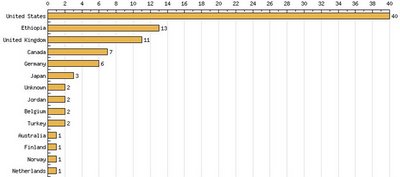
The response from the Ethiopian blogosphere to the blockade was to educate Ethiopians at home on ways to bypass the blockade and to put a "Do Not Enter" sign in a prominent place on the blocked web sites and blogs to publicize the government's futile attemt to suppress the free exchange of information and ideas. The blockade lasted for about three months, and in the end the government blinked. To my knowledge, no blogger or webmaster has bothered to change the internet domain they are running on. Anyhow, the government could have easily added the newer domain names to its list of blocked URLs just as it did with the current ones, and it would have been a waste of time to change a domain name because of the blockade.
Why the Addis Ababa regime decided to unblock the web sites is anyone's guess. But it seems to me that the government probably decided that the criticism it has been getting from the donor community for its continued blocking of these web sites got to a point beyond which it could not defend its actions. I have a feeling that a lot of folks from the donor community in Addis peruse these blocked web sites and blogs to gauge the temperature of the Ethiopian political scene and they probably did not like being inconvenienced in accessing these web sites and blogs.
As important as these web sites and blogs may be in the evolution of freedom of expression in the Ethiopian political culture, their importance pales in comparison with the role that was played by the independent newspapers and magazines that are now silenced by the regime in power. The Addis Ababa regime must realize that the road it has chosen in the aftermath of the May 2005 elections is a dead end one and it will never be able to silence the Ethiopian people by continuing to jail journalists who criticize it. Therefore, it should release all journalists and the thousands of political prisoners it currently holds in its rotten jails immediately and without any preconditions.
In any case, I welcome the government's action to unblock these web sites and blogs. However, the "Do Not Enter" sign on this blog will remain until such a time that the lifting of the blockade is widely acknowledged as not being a temporary measure on the part of the regime.
Since earlier this summer the Ethiopian government has been blocking most web sites and blogs (this one included) that are critical of it. Apparently that blockade is over, at least for now, as you can see from the graph below for the countries of the last 100 visitors to Enset blog from today and as confirmed by a recent posting on Seminaworq, a blog run from within Ethiopia.
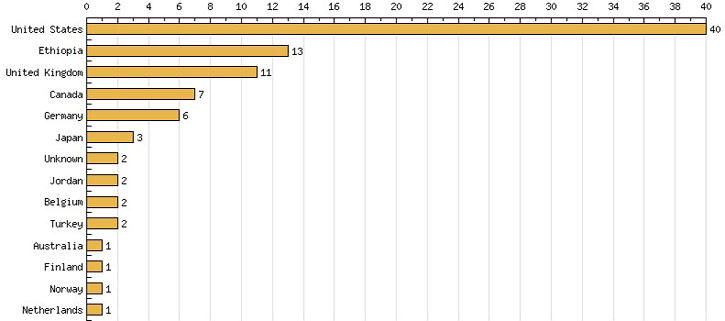
The response from the Ethiopian blogosphere to the blockade was to educate Ethiopians at home on ways to bypass the blockade and to put a "Do Not Enter" sign in a prominent place on the blocked web sites and blogs to publicize the government's futile attemt to suppress the free exchange of information and ideas. The blockade lasted for about three months, and in the end the government blinked. To my knowledge, no blogger or webmaster has bothered to change the internet domain they are running on. Anyhow, the government could have easily added the newer domain names to its list of blocked URLs just as it did with the current ones, and it would have been a waste of time to change a domain name because of the blockade.
Why the Addis Ababa regime decided to unblock the web sites is anyone's guess. But it seems to me that the government probably decided that the criticism it has been getting from the donor community for its continued blocking of these web sites got to a point beyond which it could not defend its actions. I have a feeling that a lot of folks from the donor community in Addis peruse these blocked web sites and blogs to gauge the temperature of the Ethiopian political scene and they probably did not like being inconvenienced in accessing these web sites and blogs.
As important as these web sites and blogs may be in the evolution of freedom of expression in the Ethiopian political culture, their importance pales in comparison with the role that was played by the independent newspapers and magazines that are now silenced by the regime in power. The Addis Ababa regime must realize that the road it has chosen in the aftermath of the May 2005 elections is a dead end one and it will never be able to silence the Ethiopian people by continuing to jail journalists who criticize it. Therefore, it should release all journalists and the thousands of political prisoners it currently holds in its rotten jails immediately and without any preconditions.
In any case, I welcome the government's action to unblock these web sites and blogs. However, the "Do Not Enter" sign on this blog will remain until such a time that the lifting of the blockade is widely acknowledged as not being a temporary measure on the part of the regime.
Saturday, August 12, 2006
An Open Letter to Sheikh Hassan Dahir Aweis
By Liban Ahmad
I am writing this open letter to you in the hope of adding my voice the many Somalis who shared ideas with you so as not to see the efforts of the United Islamic Courts of Somalia become an exercise in futility, and your personality a byword for demagoguery.
I believe that successive Somali governments (former Transitional Somali Government and current the Transitional Federal Government) failed to address the question about Somalis whose names are included in the suspected terrorist list of several countries. My unease over our selected leaders' approach to the question stemmed from the fact that failed states like Somalia has no time to harbour terrorists. Foreign countries want reassurance that Somali citizens are not involved in terrorism. That is partly the job of any Somali government.
You are a Somali citizen and a political and religious leader as well. Like it or loathe it, your actions and judgement will have ramifications for national reconciliation.
You were quoted as saying that the Islamic courts will go the southern parts of Galkacyo "because people from that town want the courts there." If the quoted words are yours, I doubt you are acting out of your Muslim heart; you may be acting out of your tribal heart. Reason: your actions may destroy the 13 year old agreement that led to peaceful coexistence in Galkacyo. Damages may outweigh benefits. You will be remembered for failing to understand what the late General Mohamed Farah Aideed and President Abdullahi Yusuf had understood: that they have obligation to work towards peace in Galkacyo.
You have an obligation to rein in any members from Southern Galkacyo who might be carried away by the UIC's swift victory over warlords. Failure to do that will mean you are sanctioning clan warfare. A sense of history can be of help to you. And remember that "the study of history is a powerful antidote to contemporary arrogance."
Remember that the name you use -Islamic Courts- always gives wrong impression: Somalia has never lived under an Islamic state nor did it have an effective central government for the past fifteen years. How can a religion and clan based group administer justice when courts are known by clan names? The court of Sacad, The court of Abgaal, The court of Sheekhaal, the Court of Raxanweyn, the Court of Marehan etc, etc? Do you think that Islamic state will thrive if one adopts grassroots approach that empowers every clan to become a state within a state? Have you forgotten the countless Somalis who were killed or maimed on the basis of the clan they belonged to? How can justice be done under an unjust designation?
The United Islamic Courts of Somalia are a new force that still has the potential to contribute to Somalia's future positively. The UIC's foreign policy is quite discouraging. What benefit will Somalis gain if our energy that can be channelled to nation building and national recovery is directed towards antagonising neighbouring countries to achieve personal aspirations?
Whose task is it to formulate foreign policy? The Transitional Federal Government of Somalia (TFG) or the United Islamic Courts of Somalia? Already the presence of United Islamic Courts have affected the relation within The TFG troika-Parliamentary Speaker Shariif, President Yusuf and Prime Minister Geeddi. This is not a small feat. It shows that the TFG is ready for power-sharing. The Transitional Parliament has one virtue: it is pyre of personal ambition aimed at serving clan interests. Every top politician can be challenged. MPs may be fractious but they debate issues candidly.
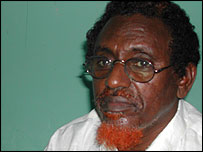
Sheikh Hassan Dahir Aweis: Misguided or Pious?
As a Sheikh you have obligation towards Allah and towards people who regard you as an example to follow. Avoiding any unprovoked action or any move that may have adverse consequences for Somali clan relations ought to be uppermost in your mind. Why so keen on opening a questionable court in a part of Somalia that has benefited from self-rule, that has not been blighted by warlords? Don't you think that such actions can create major disagreement on governance for Somalis in the future? Do you want Somalia to become like countries that instituted Sharia law in some parts while other parts use secular laws? Why so keen on being regarded as Amiir Muminiin in Somalia when your words and actions polarise people who have coexisted peacefully? Remember that religious innovation is a sin in Islam. Why do you combine elements of Jahiliya with basic Islamic precepts?
Many people have raised questions about Hargeisa based Court's desire to see you in court so you can answer questions about your alleged role in the murder of expatriates in 'Somaliland'. Do you think those people will be on your side if you choose to become a DEMAGOUGE?
You blame members of the TFG for being pro-Ethiopia whereas your actions seem to be endangering peaceful coexistence on which Somalis agreed without the help of any foreign country! Can't you see the contradiction in your words and actions?
May I anticipate that wisdom and foresight prevails in Somalia.
Monday, August 07, 2006
The Dilemma Facing Somalis
By Fikru Helebo
Imagine that you are a Somali expatriate living in North America or Europe and that you are hearing the good news that has been coming out of Somalia in the last couple of months, the good news that for the first time since 1991, when rival warlords who overthrew the Barre regime made most of southern Somalia ungovernable, life in the capital city of Mogadishu is getting better under the rule of the Islamic Courts Union, now renamed the Supreme Islamic Courts Council (SICC). And then imagine hearing that this group that has brought much needed stability to a significant portion of southern Somalia is beginning to impose a strict form of Sharia law that is reminiscent of Afghanistan under Taliban rule.
If you are a Somali watching events unfold from afar, what would you do? Should you give the benefit of the doubt to SICC in the hope that it will institute a benign form of Islamic government in the areas it controls, or support the Transitional Federal Government (TFG) of Somalia that is recognized by the international community but has very little authority in Somalia itself? This is the dilemma that a lot of Somalis are wrestling with these days, as it is evident from the plethora of articles that Somali expatriates are writing about current events in their homeland. Here below are some samples:
"Another Afghanistan Could Be Averted"
By Abdifatah Ismail (South Africa)
"Actions and inactions by Western governments contribute to the current events in Somalia"
By Mohamed Mukhtar Ibrahim (United Kingdom)
"The Struggle for Somalia: Warlords, Islamists, US Global Militarism and Women"
A Somali Woman Discusses the Sharia Court and Her Cousin Who Leads It
By Amina Mire (Canada)
"Why Ethiopia-bashing Is Not The Right Option For The United Islamic Courts Of Somalia"
By Liban Ahmad (United Kingdom)
It is sad to see the circumstances that the Somali people had to endure in the last 15 years, and there is no question that interference by foreigners, including Ethiopians, in Somali internal affairs has contributed significantly to the failure of the Somali state and the many attempts to reconstitute it. However, the main obstacle to reconstituting a central government in Somalia remains the unhealthy premium that the Somali society places on its clans, which only the Somalis themselves can remove.
Comparing Mogadishu's current Islamist rulers to the Taliban may be a bit of a stretch at this point. However, there is an eerie similarity between the route the two groups took in their rise to power -- both of them offered an Islamic fundamentalist ideology, radical political Islam, as an antidote to the lawlessness and chaos that ravaged their respective countries. This similarity coupled with the recent history of radical political Islam in inspiring terrorism and suppressing basic human rights is a very good reason to be alarmed about the rise of the Islamists in Somalia. Ethiopia, Somalia's neighbor and rival, with an estimated Muslim population of at least 30 million of which 4 million are ethnic Somalis, can not afford to have a radical political Islam take root in its backyard. Neither does Somalia!
Subscribe to:
Posts (Atom)