
Friday, June 30, 2006
A Drill for False Alarm, the Solitary Journey of UEDF
By Ephrem Madebo
In the last fifteen months the political reality of Ethiopia has constantly been changing. The dynamic emergence, fallout, and re-emergence of events have forced both the opposition and the TPLF to change their strategy and adopt to the daily changing political environment. In my opinion, all the major political parties have sensed the dynamics of the Ethiopian political situation, but none have paid due attention to the changing events like the OLF and TPLF.
Political victory is unthinkable in the absence of battle seasoned leaders and a proactive party leadership. I have a great respect and appreciation for CUDP, but with its entire leadership suffering in jail, the ability of CUDP to stay proactive in Ethiopia's fast paced political life is minimum. In fact, the recent creation of CUDP international leadership is a wonderful move that shows the political maturity of the CUDP leaders in keeping the party ahead of events. Evidently, the CUDP international leadership was created to align the party's strategy with the changing political conditions. With all due respect to UEDF, I do believe that UEDF is a reactive party that suffers from a self-inflected wound. UEDF proudly presents it self as a pioneer party that started a political dialog with OLF, yet the same UEDF blames OLF and CUDP for forming a forum for dialog. According to my understanding, the purpose of the OLF-UEDF dialog was to forge a unity. If so, why run away when the foundation for unity is laid down?
On Sunday June 25, 2006, I was one of the many people who ignored the formidable rain and flood of the Washington, DC area to attend the much awaited meeting called by UEDF. As eager as I was to hear UEDF's position [on AFD] from the mouth of the horse, I was shocked and simmered in total disbelief when I heard a poor unedited essay that lacked coherence and thesis statement. Most of the participants of the meeting challenged and questioned the solitary journey of UEDF and demanded reason for such an act, but instead of reason, the audience was given a sermon that black mailed and repeatedly accused CUDP. According to the sermon on Sunday, UEDF is the only party that cares for Ethiopia's unity and challenges the TPLF constitution.
Most of the six point contentions of UEDF are technical in nature and could have been solved in the AFD forum. In fact, the contentions were good reasons to join AFD, not to run away and cry like a child who spills his own food. My advice to UEDF: All the time that you spent analyzing the Ethiopian political problem is greatly appreciated, but no matter how devoted and how courageous you are in analyzing problems, your effort will not bear fruits unless you match your time of analysis with synthesis. Remember, both analysis and synthesis are group efforts. Please join the group and work together with CUDP, OLF, ONLF, EPPF, and SLF.
As we all know, for the good part of the past thirty years the OLF carried a secessionist slogan and distanced itself from most mainstream Ethiopian political parties. In the other side, most mainstream Ethiopian political parties treated OLF as an ordinary terrorist organization and made no attempt of political cooperation with this giant thirty three years old organization. As a result of this meaningless and cold standoff, the Ethiopian people journey to justice and democracy lost the synergy that could have come from the political co-operation of OLF. The historic May 2005 election refuted the use of force [Gun] to achieve political goals in Ethiopia and gave a nice lesson to the ubiquitous ethnic liberation fronts. To be honest, in May 2005, when most Ethiopians went to the ballot box, they knew less what the vision of the opposition really was, however, they voted for a start-up party in a larger proportion because they were dead sure that the alternative was evil and they were eager to see a peaceful transfer of power.
In May 2005, the majestic appearance of CUDP and its young visionary leaders captured the imagination of many Ethiopians. As a result many urban Ethiopians gave their vote to CUDP. In Ethiopia we don't have a rural urban political divide, therefore, it is odd to have a landslide victory in urban centers and a disproportionate loss in rural areas. Large urban centers like Addis Ababa, Awassa, Jimma, Nazereth, Bahar Dar, and Dire Dawa are places where true Ethiopian diversity is expressed. Why would Oromos that live in Addis Ababa and other urban areas vote for the Opposition, and those who live in the rural area vote for the EPRDF? It is the answer to this kind of statistical and sociological question that forced the OLF to reconsider its long standing and obsolete colonial question. In deed, in the last six months the political tone of the OLF has changed dramatically. High ranking OLF officials have started envisioning democracy and justice to the Oromo people in the context of a united Ethiopia. Here are recent excerpts from two OLF officials:
"The future is doomed only for those who fear equality, democracy and freedom, and for those who uphold and condone injustice, inequality and dictatorship. I say freedom now, equality now, democracy now for all peoples of Ethiopia, and Freedom and Democracy for all" Dr. Shigut Geleta, OLF Head of Foreign Relations in Europe
"If the international community and the others in Ethiopia are ready to be serious and to seriously look to resolve the complicated problems in Ethiopia, OLF is ready to be a leading partner in this change" Dawud Ibsa, OLF Chairman
For a long time OLF was obsessed with the creation of Oromia state while other political parties were tormented by every move of the OLF to make the state of Oromia a reality. In this destructive zero sum game where neither the OLF achieved its goal nor the pro-unity parties faced their fear, the only beneficiaries were the enemies of Ethiopia. Retrospectively speaking, the short lived pre-election democratic face of the TPLF regime was a tantalizing empty promise. Currently, we as a society are so close to freedom and democracy, but we are guarded afar by TPLF from concretely holding to it. There is no question that TPLF is a voracious predator, but in the face of a united opposition, TPLF is not a formidable enemy. Our dreadful enemy is our inability to unite.
Ethiopia finds it self at a time where the unity of the opposition parties is a necessity, not a choice. Our nation is at the verge of disintegration; if Meles realizes his diabolic dream, the OLF would have no Oromia to separate, CUDP would have no place to unite, and UEDF would have no country and constitution to brag about. UEDF, CUDP, and OLF should understand that they exist in the context of each other. Accepting and exploring the rich context of their differences does not imply defeat or loss. Nor does it mean surrendering their own intellectual, aesthetic, or moral perspective. It simply means that they gain a deeper and broader understanding of where their own views fit in with society. That, in turn, helps them to navigate society more effectively.


Thursday, June 15, 2006
Article 39, AFD and the Oromo Liberation Front.
By Ephrem Madebo
The United States constitution was written almost six decades before Emperor Teodros II consolidated his authority and unified the Ethiopian empire. When George Washington became the president of the United states the Union has only 13 states. Between 1789 and 1959 thirty seven more states joined the union. Toady, there are fifty states in the union. What attracted the last 37 states to the Union? The answer is easy, it is the constitution. The US constitution grants equal freedom and justice to all. The farsighted founding fathers dreamed a larger, wider, and stronger America, hence, they wrote a constitution that attracted a human wave of immigrants. As a result, today, the United States of America is the sole superpower, the richest country, and the model of representative democracy.
Article four of the US constitution describes the relationship between the states and the Federal government, and amongst the states; it also has provisions for the creation and admission of new states. However, the US constitution never mentions the concept of self determination or secession. In fact, the Civil War would have reduced the Union in to many weaker countries had something similar to article 39 of the Ethiopian constitution was enshrined in the constitution of the Unites States. Why did the founding fathers who lived two centuries ago leave a blue print for a larger and richer America? Why did TPLF write a constitution that disintegrates one of the oldest country of the world? Why didn’t TPLF learn from the American experience and leave a blue print of unity to all of us and to Posterity?
Article 39 of the Ethiopian constitution states: Every Nation, Nationality and People in Ethiopia has an unconditional right to self-determination, including the right to secession.
OLF Mission Statment: The Oromo Liberation Front (OLF) is a political organization established in 1973 by Oromo nationalists to lead the national liberation struggle of the Oromo people against the Abyssinian colonial rule. The emergence of the OLF was a culmination of a century old yearn of the Oromo people to have a strong and unified national organization to lead the struggle.
OLF Objective: The fundamental objective of the Oromo liberation movement is to exercise the Oromo peoples' inalienable right to national self-determination to terminate a century of oppression and exploitation, and to form, where possible, a political union with other nations on the basis of equality, respect for mutual interests and the principle of voluntary associations.
OLF Policy (taken from the OLF policy statement): The Oromo and other oppressed peoples are endowed with the right to decide the form of sovereignty they want, whether on their own or in a union with others on the basis of freely expressed consent of all concerned parties.
There is no question that many opposition parties, political organizations, civic organizations, and the Ethiopian people at large oppose article 39 of the constitution in its entirety. Article 39 explicitly endangers Ethiopia’s existence as a nation, and it is included in the constitution against the will of the Ethiopian people. The social and economic development of Ethiopia is highly dependent on the unity of the Ethiopian people, therefore, no Ethiopian would be happy to see an article in his/her constitution that could reduce the size, political, and economic importance of Ethiopia. With all due respect to the OLF as a major representative of the Oromo people, I don’t think that all Oromos agree on the separation of Oromia from the rest of Ethiopia.
A closer look to article 39 of the constitution clearly indicates the existence of a harmonious relationship between article 39 and the objective, policy, and mission of the Oromo Liberation Front. In fact, such a harmony is not a coincidence. In 1991, when EPRDF controlled Addis Ababa, and wrote the current constitution, OLF was part of the Transitional Government that ratified the constitution. As we all know, in the last twenty five years, the armed wing of the OLF was in action to separate Oromia from Ethiopia, therefore, as far as OLF is concerned, enshrining Article 39 in the constitution was a dream come true.
In 1991, when the two ethnic liberation fronts [OLF, TPLF] agreed to insert Article 39 in the constitution, the future of Ethiopia did not seem to be their cup of tea. I don’t even think the two liberation fronts deeply thought about the long term economic and social development of the Oromo and the Tigray people. As a member of one of the neglected nationalities of the south, I do share the pain of the Oromo people, but nothing happened to the Oromo people that did not happen to the people of my nationality. I’m a person who believes that the OLF should lead the Oromo people to a lasting victory. But, victory over what? In my opinion, victory to my nationality is victory to the Oromo people, and the vice versa.
If the Ethiopian opposition is capable of creating a political and social order that guarantees freedom, equal justice for all, and equitable wealth distribution, what is the value of creating a weaker independent states of Tigray, Oromia, Ogaden or Sidama? What people want is freedom and democracy, seceding from Ethiopia does not guarantee justice and democracy. The Eritreans fought for freedom, democracy, and justice. Today, fifteen years after independence, the fate of Eritreans is decided by a ruthless dictator Africa has never seen. Ethiopia, the very country that they vowed to never see again is a safe heaven to Eritrean dissenters and draft dodgers. It is amazing that a non-democratic Ethiopia is where Eritreans are looking for freedom.
In the last one month many articles have been written regarding the formation of AFD. Some have supported the alliance, some opposed it, and yet some others were too cautious to take a definitive stand. One of the most boisterous whimper regarding AFD was its nomenclature. Obviously, nomenclature is very important, however, nullifying the AFD at this stage because it lacks the word Ethiopia in its name is political immaturity. Let’s not forget that CUDP was a coalition of four parties, but it doesn’t have the name Ethiopia in it. Many writers have demanded the OLF to drop its secessionist policy, this is a valid demand, however, asking an organization to drop its 33 years objective overnight is being a little hasty and a little far from reality. At this juncture the ability of the opposition to create an alliance that embraces parties of diametrically opposing objectives is a victory by itself. Now the primary and the most difficult part of the task has been accomplished.
In its next several steps, the alliance should attract other parties and avoid contradicting objectives of member parties through extended dialogues. We should all understand that AFD might not at all solve Ethiopia’s problem, but it has opened a forum that was non-existent in Ethiopia. In the history of the Ethiopian opposition, the Oromo Liberation Front has agreed to work together with parties that strongly advocate Ethiopia’s unity. Now the ball is in the court of CUDP and other pro-unity parties. The ultimate goal of the liberation organizations [OLF,SLF, ONLF] and the pro-unity parties is identical. They all strive to lead their respective constituencies towards peace, democracy, and prosperity. The major difference between the parties is the tools they use and the path they travel towards their goal.
Is AFD capable of converging the different paths perused by the different parties? Yes, and It should, because preserving Ethiopia as it is, or the status quo is a Win- Lose game, reducing Ethiopia in to multiple small states is a Lose-Win game. Granting democracy, justice, and economic prosperity to all Ethiopians is a Win-Win game. Selecting a winning strategy for any particular party is easy. However, one doesn’t come to an alliance to play individual game. An alliance is a place where every party comes to win, and it is also a place where every party plays a fair game so that others win. To be specific, when trust develops between and within the parties, and when AFD fully matures, no individual party should have a reason to change its behavior given the choices of all other parties.
It is apparent that most Ethiopians expect the AFD to solve the age old political problem of Ethiopia, but make no mistake, the Alliance for Freedom and Democracy has the potential to harm Ethiopia by being the instrument of another brand of ethino- nationalists. The OLF is composed of people who strongly believe in unity and solve the Oromo problem within the framework of greater Ethiopia. Of course, there is another radical group that advocates separation. Currently, the AFD is packed with secessionist forces, pro-unity parties, and by some who can go either way. What should CUDP and other pro-unity parties do and not do to convince OLF change or avoid its secessionist policy? What should the OLF do and not do to earn the trust of the pro-unity parties? The success or failure of the AFD depends upon who plays smart in this game of give and take.
CUPD has repeatedly showed its unwavering stand on Ethiopia’s unity. In its recent and past press releases, we have clearly seen UEDF’s unflinching stand of unity. Now it is about time that these two vanguard parties stop their verbal war and show us their maturity by integrating their political program in to a common work plan. UEDF should reconsider its current stand. The process of how AFD handles the complex problems of Ethiopia can be redesigned, and in the real world a political process is redesigned by the people inside, not out side. My most important message to UEDF and CUDP is that they should both keep their eyes on TPLF, not on each other.
Ethiopia has been a mother to some and a step mother to others. Many nationalities of Ethiopia who once governed themselves were denied political power, economic freedom, and social justice by the four consecutive regimes that took power in Ethiopia between 1889 and 2006. The political, social, and economic problems of the past 117 years did not come from living together as a nation, and will never be solved by breaking the unity of Ethiopia. When the Chinese foresee our tremendous market potential and invest in billions, working hard to reduce ourselves in to minuscule local markets is a disgrace and an out and out blindness. The instinct of people is to live together and cherish the fruits of democracy and economic prosperity, therefore, one does not librate people from people. Today, we have a government that uses constitutional power to create and enforce public policies that advance the objectives of the Tigray elite. TPLF is the common enemy of the people, the Ethiopian people should be liberated form TPLF, not from each other.
The OLF, the SLF, and the ONLF should understand that the strength of the Oromo, the Sidama, and the Somali people comes from living together with the Amharas, Tigreans, Sidamas and Walaytas etc. The Oromo or the Sidama problem is not and has never been a colonial problem. Any attempt to solve the Oromo problem in the framework of colonialism is tantamount to treating a malaria patient with chemotherapy. To reiterate my point, uneven distribution of wealth, political domination, and social injustice have always been the root causes of Ethiopia’s problem. We can solve our problems only if we manage to handle the root causes of the problem. We have already identified and analyzed our problem, now it is time to look for a set of solutions. Remember, too much analysis is paralysis.
Monday, June 05, 2006
D. Yamamoto and His "Positive Talks" with the Ethiopian Government
By Ephrem Madebo
At the End of May 2006,Donald Yamamoto, US Deputy Assistant Secretary of State for African Affairs paid a working visit to four African countries including Ethiopia. In his trip to Ethiopia, the Assistant Secretary focused on political and economic reforms in Ethiopia, and the border dispute between the two poverty stricken nations of Africa, Ethiopia and Eritrea. The Deputy Assistant Secretary described the current political situation in Ethiopia as "It remains ongoing"; and he said: "We’ve had some successes and areas that we haven’t made enough progress on".
It is perplexing that Mr. Yamamoto acknowledges TPLF’s mysterious handover of the administration of Addis Ababa to political appointees, but the Assistant Secretary reduces this important issue to a simple disagreement between EPRDF and the opposition, moreover, Mr. Yamamoto failed to point out the specifics of his country’s position on the solution to this grave problem. In his most recent trip to Addis Ababa, Mr. Yamamoto did not pressure the Ethiopian government to free the jailed opposition leaders and transfer the administration of Addis Ababa to elected officials. As an Ethiopian American tax payer, may I ask the Deputy Assistant Secretary why he used my tax money to go to my native country? Every thing he said and every example he used in the interview was an old public knowledge, I expected the Secretary to use this knowledge to pressure the Ethiopian government to free the leaders that my mother and father elected.
On issues of introducing political reform in Ethiopia, here is what Mr. Yamamoto said: "We continue to work though on the positive side, which is with other countries such as UK, India, Germany, on the political reform and how the Parliament is to operate. We’re working on media law and media in general, and hopefully that these could help with the process of political reform. But we have a long way to go and many issues to tackle" It is absolutely important to learn form the experience of democratic countries, but is it possible to solve the political problem of Ethiopia with UK, USA, Germany, and India on one side and TPLF on the other side? Where is the participation of the entire Ethiopian opposition? Mr. Secretary, how can you introduce political reform and improve the operation of the parliament in a multi party country where MPs and opposition party leaders are in jail?
Regarding the detention of the opposition leaders, this is what Donald Yamamoto said: "The official position of the United States is for the release of the detainees, period" In a follow-up statement the secretary said: "I’ve visited the detainees and had great discussions with them. In some cases, they are able to hear the Voice of America, so the Voice of America is critical, very important, to gain information in Ethiopia" In the long run, I would definitely be happy if I am allowed to know the un-official position of the US regarding the detention of Ethiopia’s political leaders, if there is at all such a thing as un-official position. Currently, the US is not showing any sign of pushing or guiding the Ethiopian rulers towards where it believes is the right direction. Mr. Yamamoto, thank you for the visit you paid to the prisoners of conscience, but what is good if the prisoners hear the voice of America(VOA), but not the voice of the American government? You said the official position of the US government is for the release of the prisoners, if so, why doesn’t the US government put its money where its mouth is?
Any political analyst that reads the transcript of Donald Yamamoto’s interview can see that the United States is trying to appease both the opposition and the TPLF regime. In the past the United States has used its political and economic muscle to force totalitarian regimes to release political prisoners. I guess we all know the difference between "releasing prisoners" and "speedy trial". What is the demand of the United States of America? Is it releasing the prisoners, or speedy trial? The irony is that on one side, no matter what the demand of the US government is, the Ethiopian government is not showing any sign of releasing the prisoners or granting them speedy trial. On the other side, no matter what the Ethiopian government does the US is quietly watching. In a diplomatic language such quietness is nothing, but approval or an invisible nod for acknowledgment.
Another important question presented to Donald Yamamoto was- Is reconciliation possible with virtually the entire leadership of the largest opposition party in prison? Ambassador Yamamoto’s reply to the above question was: "The Ethiopian government’s position is that they committed a crime and that they need to go through the trial process. That’s their decision but we have argued that they should be released and take up their seats in Parliament" There are some important questions that need to be raised here - What is the official position of the US government regarding the political prisoners in Ethiopia? Is it to negotiate and/or put pressure on the Ethiopian government to release the political prisoners? Or is it demand for speedy trial? If the former is true, then the US government agrees on the innocence of the CUDP leaders. In this case, the US should use its political and economic power to grant an immediate and unconditional release of the CUDP leaders. If the latter is true, then the US has agreed on the fabricated charges of genocide and treason. The truth is that the opposition leaders are jailed for exercising their constitutional right of freely expressing their ideas, a right that all the citizens of the United States take for granted.
Currently, the Ethiopian people expect two things form the United States government. First, the US government should engage itself in helping the Ethiopian people build a democratic system. The US shouldn’t support an outrageous dictator just because the dictator promises to fight terrorism. Terrorism is the enemy of democracy, as long as the Ethiopian people do not enjoy their God given democratic right, there will always be an open door that allows in the elements of terror no matter what the Ethiopian government does. It is important to prevent the symptoms of terrorism than trying to fight a fully blown terrorism. Second, we Ethiopians don’t expect the Americans or any country to build a democratic system in Ethiopia. The building it self should be left for Ethiopians, however, the US and other donor countries should make sure that the aid fund that flows to Ethiopia advances the principles of the democratic process, the Ethiopian people should be the direct beneficiaries of aid fund, not few elites! The US should learn from the mistakes it made in Chile, in the Mobutu era Zaire, and in the Apartheid era South Africa.
Tuesday, May 30, 2006
The Battleground Region
By Fikru Helebo
A full year has passed since the May 15th 2005 elections, elections that briefly gave hope for a nation that has never known good political leadership in its modern history. And a lot has been written about the fact that the elections were neither free nor fair and about the political turmoil that ensued in the aftermath of the elections. The fact that the ruling party, the EPRDF, stole victory from the combined opposition* is undeniable to most analysts who follow Ethiopian politics closely. If you are one who still doubts whether or not the EPRDF stole the May 2005 elections from the Ethiopian people, then an analysis of the elections at the Ethiopian News and Views web site here is a good place to start.
In this article I would like to focus on the result of the elections from the Southern region. In my opinion, the result of the elections from the Southern region (SNNPR), a region constituting at least 20% of the Ethiopian population, is of high importance since the result shows that this is the only region of Ethiopia where the elections were hotly contested by more than two parties in a great majority of the constituencies. The implication of this for the next elections, if they are to be free and fair, is that the Southern region will most likely be the region where the contest for the control of parliament in its current form, with 547 seats, will be the closest, making it the battleground region of the next election.
In the two most populous regions of the country, the two largest opposition groups will dominate the elections without a doubt. The Oromo Liberation Front (OLF), if it is wise enough to put its trust in the will of the people and enter electoral politics, will most certainly be the dominant party in the Oromo region, where 178 seats are allocated for the region, and the Coalition for Unity and Democracy (CUD) with a strong support base among the Amharas will do very well in the Amhara region, where 138 seats are allocated to the region. With 274 seats in parliament needed to form a governing majority, the OLF and the CUD will then need to do well on their own in the other regions or form alliances with other parties of similar persuasion who have strong following in regions other than Amhara or Oromo.
This is where the Southern region comes in to the picture. The Southern region, with 123 seats allocated for it in parliament, is the third largest region in the country and a rich vote mine for a party that can appeal to the seemingly divergent interests of the various ethnic groups that make up the Southern region. Although the Southern region was created in 1992 without the consent of the governed, the 2005 elections have demonstrated that the region has a political clout that rivals that of the Oromo and Amhara regions, if only the political class of the region know how to take advantage of it. To understand why the Southern region is of great importance for a winning strategy in the next election, it is imperative that one look at the election data for the region from the May 2005 elections which is available at the web site of the National Electoral Board of Ethiopia (NEBE).

Figure 1
The first thing you will notice in Figure 1 is that the EPRDF got 49% of all the valid ballots cast in the Southern region on its way to "winning" 93 out of the 123 seats allocated for the Southern region. Now, if anyone can convince me that one out of two Southern Ethiopians did really choose the EPRDF over the opposition candidates which were available for them, then I will be the first one to congratulate the EPRDF for its victory. This can't possible be true since the EPRDF is deeply unpopular among Southerners. Let alone half the votes, it can not win a quarter of votes in the Southern region in a free and fair election. The EPRDF winning in the South is simply an unthinkable proposition and I will not waste any more of your time to try to convince you that the EPRDF was not the choice of Southern Ethiopians in the May 2005 elections.
The more interesting data in Figure 1 is how well the relatively new party, the CUD, did in the Southern region despite the fact this was its very first entry on the ballot in the South. According to the NEBE figures, the CUD won 18 of the 123 seats for parliament by taking 22% of the 3,664,404 valid ballots cast in the Southern region. Whereas the more established party in the South and one that participated in the May 2000 elections in the Southern region, the United Ethiopian Democratic Forces (UEDF) / Southern Ethiopia Peoples Democratic Coalition (SEPDC), won only 12 seats by taking a meager 10% of all the valid ballots cast in the Southern region, which is 5% less than the votes Southerners gave to candidates other than the four major contenders in the South.
Figure 2
Another set of interesting data can be found in Figure 2 above where the percentages of the valid ballots cast in the May 2005 elections is given for the three major opposition parties in each zones of the Southern region. There were more than twice as many valid ballots cast for the CUD (792,633) as there were for the UEDF/SEPDC (363,151). The CUD was strongest in Gurage zone, wining 10 of the 13 seats available by taking 56% of the valid ballots cast. The UEDF/SEPDC was strongest in Hadiya and Kembatta Tembaro zones, winning 12 of 16 seats available and taking 45% and 44% of the valid ballots cast in the two zones respectively. In zones out side of Hadiya, Kembatta Tembaro and Gurage zones, which were stronghold zones for the UEDF/SEPDC and the CUD, the CUD did significantly better than the UEDF/SEPDC, taking 21% of the valid ballots cast to UEDF/SEPDC's 8%. Of particular note was CUD's far better performance in Wolaita and Gamo Gofa zones where the CUD took 29% and 33% of the valid ballots cast compared to UEDF/SEPDC's 6% and 3% respectively.
In Figure 2, it is interesting to note that the total valid ballots cast in Sidama zone (743,604) comprised 20% of the total valid ballots cast in the entire Southern region. This is almost the same as the next two vote rich zones combined (22%). The Sidama zone is the only major area in the South where a party that is based on a single ethnic identity, the Sidama Liberation Movement (SLM), did well by taking 19% of the valid ballots cast. If the elections were free and fair, there is no question that the SLM or other Sidama-based parties would have won most of the 19 seats available in Sidama zone. It is also worth noting that the CUD did well in Sidama, taking 17% of the valid ballots cast in this pivotal zone of the Southern region. The UEDF/SEPDC was not on the ballot in Sidama. It seems that it may have defered to the SLM in Sidama zone.
The election results from the Southern region offer us a lot more than just statistics; I believe it offers us a glimpse into the future of Ethiopian politics. There are two opposing voting trends that can be drawn from these election results. The first and obvious trend is that the CUD has become a party of choice among Southerners who would like to see an end to the ethnicization of politics. The second and less obvious trend is that ethnicity still is a powerful factor in Ethiopian politics as was clearly manifested by the strength the SLM exhibited in Sidama zone. The strong performances of the UEDF/SEPDC in Hadiya and Kembatta Tembaro zones and the dominance of the CUD in Gurage zone can be attributed to ethnic affiliations of the leaderships of the two parties. I believe ethnicity played a role in most of the constituencies where the opposition groups did well throught the country.
I am of the view that the results of the May 2005 elections gave a clear signal to the Ethiopian political class that ethnicity should not be the driving force of Ethiopian politics. However, I am also of the view that it would be utterly stupid for a political party to think that ethnicity does not matter in politics. It does, whether we like it or not! In the evolution of the Ethiopian nation state, we have a long ways to go before ethnicity can be considered a low priority issue as it needs to be. Until we arrive at such a time though, the trick for a successful political party will be to find a pragmatic way to address the aspirations and concerns of the various ethnic groups and balance that with ideas that address their common future. The prime testing ground for this balancing act will most likely be the Southern region.
___________________________________________________________________
* I do not believe that a single political party had won the majority of the seats in parliament. The "combined opposition" that I am referring to is the CUD, UEDF and OFDM. Obviously, the CUD did far better than its main rival from among the opposition, the UEDF. The UEDF that participated in the May 2005 election is no more. It has split, albeit unofficially, into two camps: a domestic-based group led by Beyene Petros and a Diaspora-based group that is anchored by the Ethiopian People Revolutionary Party (EPRP). Since the election the CUD has wisely transformed itself from a coalition to a unitary party. However, the imprisonment of its leaders presents the CUD with major challenges ahead.
A full year has passed since the May 15th 2005 elections, elections that briefly gave hope for a nation that has never known good political leadership in its modern history. And a lot has been written about the fact that the elections were neither free nor fair and about the political turmoil that ensued in the aftermath of the elections. The fact that the ruling party, the EPRDF, stole victory from the combined opposition* is undeniable to most analysts who follow Ethiopian politics closely. If you are one who still doubts whether or not the EPRDF stole the May 2005 elections from the Ethiopian people, then an analysis of the elections at the Ethiopian News and Views web site here is a good place to start.
In this article I would like to focus on the result of the elections from the Southern region. In my opinion, the result of the elections from the Southern region (SNNPR), a region constituting at least 20% of the Ethiopian population, is of high importance since the result shows that this is the only region of Ethiopia where the elections were hotly contested by more than two parties in a great majority of the constituencies. The implication of this for the next elections, if they are to be free and fair, is that the Southern region will most likely be the region where the contest for the control of parliament in its current form, with 547 seats, will be the closest, making it the battleground region of the next election.
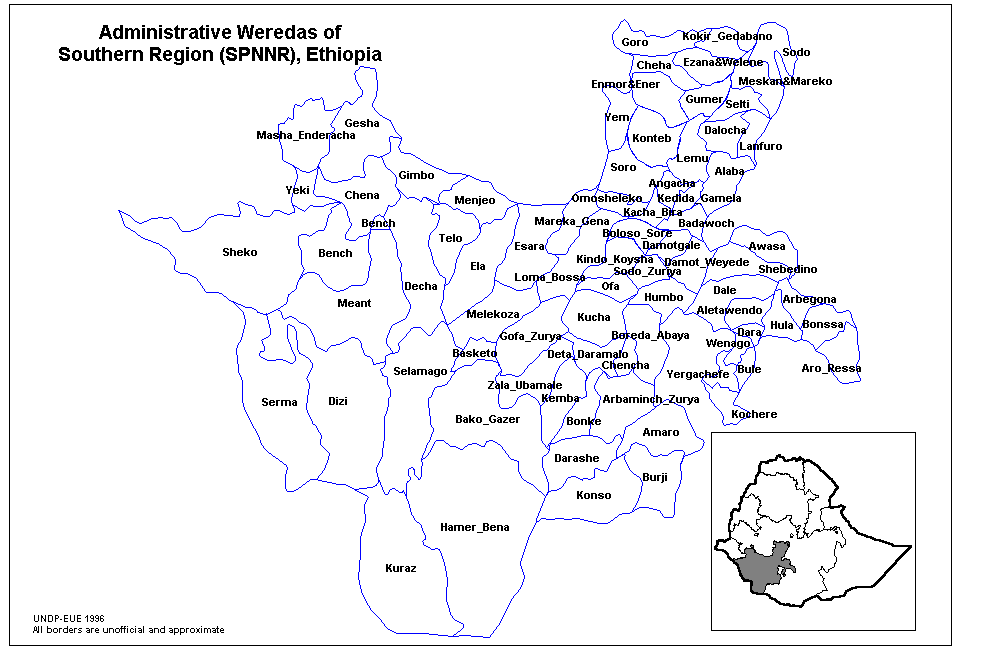
In the two most populous regions of the country, the two largest opposition groups will dominate the elections without a doubt. The Oromo Liberation Front (OLF), if it is wise enough to put its trust in the will of the people and enter electoral politics, will most certainly be the dominant party in the Oromo region, where 178 seats are allocated for the region, and the Coalition for Unity and Democracy (CUD) with a strong support base among the Amharas will do very well in the Amhara region, where 138 seats are allocated to the region. With 274 seats in parliament needed to form a governing majority, the OLF and the CUD will then need to do well on their own in the other regions or form alliances with other parties of similar persuasion who have strong following in regions other than Amhara or Oromo.
This is where the Southern region comes in to the picture. The Southern region, with 123 seats allocated for it in parliament, is the third largest region in the country and a rich vote mine for a party that can appeal to the seemingly divergent interests of the various ethnic groups that make up the Southern region. Although the Southern region was created in 1992 without the consent of the governed, the 2005 elections have demonstrated that the region has a political clout that rivals that of the Oromo and Amhara regions, if only the political class of the region know how to take advantage of it. To understand why the Southern region is of great importance for a winning strategy in the next election, it is imperative that one look at the election data for the region from the May 2005 elections which is available at the web site of the National Electoral Board of Ethiopia (NEBE).

Figure 1
The first thing you will notice in Figure 1 is that the EPRDF got 49% of all the valid ballots cast in the Southern region on its way to "winning" 93 out of the 123 seats allocated for the Southern region. Now, if anyone can convince me that one out of two Southern Ethiopians did really choose the EPRDF over the opposition candidates which were available for them, then I will be the first one to congratulate the EPRDF for its victory. This can't possible be true since the EPRDF is deeply unpopular among Southerners. Let alone half the votes, it can not win a quarter of votes in the Southern region in a free and fair election. The EPRDF winning in the South is simply an unthinkable proposition and I will not waste any more of your time to try to convince you that the EPRDF was not the choice of Southern Ethiopians in the May 2005 elections.
The more interesting data in Figure 1 is how well the relatively new party, the CUD, did in the Southern region despite the fact this was its very first entry on the ballot in the South. According to the NEBE figures, the CUD won 18 of the 123 seats for parliament by taking 22% of the 3,664,404 valid ballots cast in the Southern region. Whereas the more established party in the South and one that participated in the May 2000 elections in the Southern region, the United Ethiopian Democratic Forces (UEDF) / Southern Ethiopia Peoples Democratic Coalition (SEPDC), won only 12 seats by taking a meager 10% of all the valid ballots cast in the Southern region, which is 5% less than the votes Southerners gave to candidates other than the four major contenders in the South.
| Zone | Total Ballots Cast | CUD | UEDF/SEPDC | SLM |
| BASKETO LIYU | 11025 | 24% | 0% | n/a |
| AMEYA | 23403 | 15% | 2% | n/a |
| SHEKA | 78118 | 33% | 4% | n/a |
| ALABA LIYU | 98191 | 10% | 4% | n/a |
| DAWRO | 100910 | 31% | 4% | n/a |
| SOUTH OMO | 112632 | 16% | 8% | n/a |
| BENCH MAJI | 132029 | 10% | 10% | n/a |
| KEMBATA TEMBARO | 159628 | 7% | 44% | n/a |
| SELTI | 160785 | 3% | 0% | n/a |
| GEDEO | 233178 | 10% | 14% | n/a |
| KEFFA | 252181 | 15% | 4% | n/a |
| GURAGE | 365811 | 56% | 6% | n/a |
| HADIYA | 369040 | 5% | 45% | n/a |
| WELAYITA | 388003 | 29% | 6% | n/a |
| GAMO GOFA | 436236 | 33% | 3% | n/a |
| SIDAMA | 743604 | 17% | n/a | 19% |
Another set of interesting data can be found in Figure 2 above where the percentages of the valid ballots cast in the May 2005 elections is given for the three major opposition parties in each zones of the Southern region. There were more than twice as many valid ballots cast for the CUD (792,633) as there were for the UEDF/SEPDC (363,151). The CUD was strongest in Gurage zone, wining 10 of the 13 seats available by taking 56% of the valid ballots cast. The UEDF/SEPDC was strongest in Hadiya and Kembatta Tembaro zones, winning 12 of 16 seats available and taking 45% and 44% of the valid ballots cast in the two zones respectively. In zones out side of Hadiya, Kembatta Tembaro and Gurage zones, which were stronghold zones for the UEDF/SEPDC and the CUD, the CUD did significantly better than the UEDF/SEPDC, taking 21% of the valid ballots cast to UEDF/SEPDC's 8%. Of particular note was CUD's far better performance in Wolaita and Gamo Gofa zones where the CUD took 29% and 33% of the valid ballots cast compared to UEDF/SEPDC's 6% and 3% respectively.
In Figure 2, it is interesting to note that the total valid ballots cast in Sidama zone (743,604) comprised 20% of the total valid ballots cast in the entire Southern region. This is almost the same as the next two vote rich zones combined (22%). The Sidama zone is the only major area in the South where a party that is based on a single ethnic identity, the Sidama Liberation Movement (SLM), did well by taking 19% of the valid ballots cast. If the elections were free and fair, there is no question that the SLM or other Sidama-based parties would have won most of the 19 seats available in Sidama zone. It is also worth noting that the CUD did well in Sidama, taking 17% of the valid ballots cast in this pivotal zone of the Southern region. The UEDF/SEPDC was not on the ballot in Sidama. It seems that it may have defered to the SLM in Sidama zone.
The election results from the Southern region offer us a lot more than just statistics; I believe it offers us a glimpse into the future of Ethiopian politics. There are two opposing voting trends that can be drawn from these election results. The first and obvious trend is that the CUD has become a party of choice among Southerners who would like to see an end to the ethnicization of politics. The second and less obvious trend is that ethnicity still is a powerful factor in Ethiopian politics as was clearly manifested by the strength the SLM exhibited in Sidama zone. The strong performances of the UEDF/SEPDC in Hadiya and Kembatta Tembaro zones and the dominance of the CUD in Gurage zone can be attributed to ethnic affiliations of the leaderships of the two parties. I believe ethnicity played a role in most of the constituencies where the opposition groups did well throught the country.
I am of the view that the results of the May 2005 elections gave a clear signal to the Ethiopian political class that ethnicity should not be the driving force of Ethiopian politics. However, I am also of the view that it would be utterly stupid for a political party to think that ethnicity does not matter in politics. It does, whether we like it or not! In the evolution of the Ethiopian nation state, we have a long ways to go before ethnicity can be considered a low priority issue as it needs to be. Until we arrive at such a time though, the trick for a successful political party will be to find a pragmatic way to address the aspirations and concerns of the various ethnic groups and balance that with ideas that address their common future. The prime testing ground for this balancing act will most likely be the Southern region.
___________________________________________________________________
* I do not believe that a single political party had won the majority of the seats in parliament. The "combined opposition" that I am referring to is the CUD, UEDF and OFDM. Obviously, the CUD did far better than its main rival from among the opposition, the UEDF. The UEDF that participated in the May 2005 election is no more. It has split, albeit unofficially, into two camps: a domestic-based group led by Beyene Petros and a Diaspora-based group that is anchored by the Ethiopian People Revolutionary Party (EPRP). Since the election the CUD has wisely transformed itself from a coalition to a unitary party. However, the imprisonment of its leaders presents the CUD with major challenges ahead.
Thursday, May 25, 2006
AFD, the Flicker of hope or . . .?
By Ephrem Madebo
The people of Ethiopian have always been ready to die defending their country from external enemies, but they have been hesitant, indecisive, and reluctant to die for domestic causes. From General Mengistu Neway’s endeavor to get rid of the feudal regime to General Teferi Benti’s attempt to topple Colonel Mengistu and to the infamous "Ginbot Siminent" Military coup, Ethiopians repeatedly failed to root out internal enemies. In July 2005, 38 people died protesting the result of the May 2005 election, two months latter, another 40 people died and the entire CUD leadership was rounded up and sent to prison. Recently, in Nepal, the death of 14 people, the dusk to dawn curfew, and the number of armored vehicles around Kathmandu did not deter Nepalese from protesting and fighting for the return of the parliamentary system. In Ethiopia, the mass protest that started with upbeat took a long pose after sacrificing more than hundred people. For how long do we Ethiopians keep on sacrificing our people and yet not get the job done?
In 1991, when TPLF dethroned Colonel Mengistu and controlled Addis Ababa, OLF was part of the transition government , however, it pulled itself out of the TG because Meles and company did not want to share power with anyone outside the TPLF elite. In its 33 years history, the objective of the OLF has always been to form an independent Oromo state, and this objective has distanced many opposition parties from OLF. As a result, in the last 15 years, the Ethiopian opposition lacked a unified leadership and the political fire that could have come from the Oromo Liberation front. The recent good will and readiness of CUDP and the Oromo Liberation Front to form an alliance and work together with other opposition parties should be seen as a sign of victory to the Ethiopian people and the beginning of the end for the TPLF criminal regime.
The new beginning of AFD is qualitatively different from all past political alliances that appeared and disappeared. AFD seems to be the first alliance that truly represents all segments of the Ethiopian people, and of course the first alliance to include liberation fronts such as OLF and ONLF, once considered taboos. The recent hasty and misguided comments that dismiss the usefulness of AFD by citing OLF as an ethnic organization are myopic in nature and lack the understanding of the past and current political dynamics of Ethiopia. Yes, OLF is an ethnic organization that fights for one particular ethnic group, so are TPLF (Tigray People Liberation Front), SLF (Sidama People Liberation Front), and ONLF (Ogaden National Liberation front). As we all know , an alliance is not a forum of identical thought, it is a forum where people or groups of different ideas converge to a common idea that enables them to work together. If we closely analyze the Sidama, the Oromo and the Ogaden people, none of these people are properly represented by CUDP, UEDF or any other major opposition party. A closer look of the May 2005 election clearly shows that the Oromya, the Ogaden and the Southern zones were the three main places where EPRDF had a relatively strong footing compared to UEDF and CUDP. So looking forward for the 2010 election, why should it be wrong if CUDP and UEDF create a political alliance with OLF, SLF, and ONLF?
In Ethiopia, there are many opposition parties, but there has never been a nationally accepted alliance that has the potential to propel the popular movement, hence, the struggle of the Ethiopian people for justice and democracy was always contained by dictators. Individually, the different opposition parties have done their best to break the backbone of the TPLF regime, however, their non-co-ordinated effort couldn't damage the regime in a noticeable way. For example, when CUDP and UEDF make a call for a stay home strike, OLF orders its constituency to withhold marketable supplies, and the civic group Tegbar-League orders students and other segments of the society to wage civil disobedience; and yet there are some other opposition groups that claim to waging a parliamentary struggle. What one party considers as victory is noting to others who have a different set of objectives. How can one define success and be successful in the face of such a fragmented and disjoint objective?
After years of individual journey and fragmented struggle, it seems that the different Ethiopian opposition groups have agreed to board on the same boat and sail together. In the political history of modern Ethiopia, for the first time Ethiopians have forged an alliance that truly represents the Ethiopian people. Evidently, one should not be overjoyed with the formation of the Alliance for Freedom and Democracy by the OLF, CUDP,ONLF, SLF and EPPF, however, all Ethiopians inside and outside Ethiopia should say "AMEN" to the latest holy news that originated from the Dutch city of Utrecht. Yes, the cake is not yet baked, it is being mixed, but we can still be optimists and lend it a yeast for it will not be baked before it is mixed.
A political alliance can be stable or unstable depending on the nature of the groups that created the alliance. In an alliance, no group would compromise its underlying core value overnight, likewise, no group would join an alliance knowing that another groupn’s non-compromising core value contradicts its core value throughout the life of the alliance. Obviously, OLF, CUDP, ONLF, SLF, and EPPF, should have critically analyzed their comfort zone of give and take (compromise) before they ratified the formation of AFD. There is one important question that we all should ask ourselves - Why do people form a liberation front? From what do the Oromos, the Sidamas and the Ogaden people want to be liberated? The answer to this question is unambiguous, people want to be liberated from all types of oppression and social and economic injustice. Is there any condition that the Oromos, the Sidams, and the Ogaden people enjoy justice and democracy within the framework of a democratically reincarnated Ethiopia? If the answer to this question is yes, then OLF, ONLF, and SLF should be part of the reincarnation process. We can’t change objective realities in Ethiopia without embracing major players like OLF. In my opinion, AFD is the first stage in the process of creating a true democratic Ethiopia, therefore, Ethiopians should not deny this newly born alliance the benefit of the doubt. If we want to see AFD as a matured alliance that respects ethnic identities and transcends ethnic politics, we should clear our ethnic infested mode of thinking and work together for the formation of united Ethiopia.
The Alliance for Freedom and Democracy will achieve its goals if the member parties develop trust between each other before going in to any kind of major social contract. As we all know, the imprudent political and economic relations of the past hundred years have drained the trust that one group has for the other. Therefore, any party that desires to earn the trust of others should earn trust by trusting others. All in all, trust needs transparency, respect, and believing in democratic principles. Trust is the only factor that compels OLF, SLF and ONLF to build a united Ethiopia abandoning their long time objective of secession. The element of trust is not limited to the parties that formed the alliance, all Ethiopians should trust each other and work together by putting the past behind us. If there is a strong determination and will to correct Ethiopia’s ugly past, AFD is the sparkle of hope for millions of Ethiopians, otherwise it will be yet another marriage domed for divorce.
The people of Ethiopian have always been ready to die defending their country from external enemies, but they have been hesitant, indecisive, and reluctant to die for domestic causes. From General Mengistu Neway’s endeavor to get rid of the feudal regime to General Teferi Benti’s attempt to topple Colonel Mengistu and to the infamous "Ginbot Siminent" Military coup, Ethiopians repeatedly failed to root out internal enemies. In July 2005, 38 people died protesting the result of the May 2005 election, two months latter, another 40 people died and the entire CUD leadership was rounded up and sent to prison. Recently, in Nepal, the death of 14 people, the dusk to dawn curfew, and the number of armored vehicles around Kathmandu did not deter Nepalese from protesting and fighting for the return of the parliamentary system. In Ethiopia, the mass protest that started with upbeat took a long pose after sacrificing more than hundred people. For how long do we Ethiopians keep on sacrificing our people and yet not get the job done?
In 1991, when TPLF dethroned Colonel Mengistu and controlled Addis Ababa, OLF was part of the transition government , however, it pulled itself out of the TG because Meles and company did not want to share power with anyone outside the TPLF elite. In its 33 years history, the objective of the OLF has always been to form an independent Oromo state, and this objective has distanced many opposition parties from OLF. As a result, in the last 15 years, the Ethiopian opposition lacked a unified leadership and the political fire that could have come from the Oromo Liberation front. The recent good will and readiness of CUDP and the Oromo Liberation Front to form an alliance and work together with other opposition parties should be seen as a sign of victory to the Ethiopian people and the beginning of the end for the TPLF criminal regime.
The new beginning of AFD is qualitatively different from all past political alliances that appeared and disappeared. AFD seems to be the first alliance that truly represents all segments of the Ethiopian people, and of course the first alliance to include liberation fronts such as OLF and ONLF, once considered taboos. The recent hasty and misguided comments that dismiss the usefulness of AFD by citing OLF as an ethnic organization are myopic in nature and lack the understanding of the past and current political dynamics of Ethiopia. Yes, OLF is an ethnic organization that fights for one particular ethnic group, so are TPLF (Tigray People Liberation Front), SLF (Sidama People Liberation Front), and ONLF (Ogaden National Liberation front). As we all know , an alliance is not a forum of identical thought, it is a forum where people or groups of different ideas converge to a common idea that enables them to work together. If we closely analyze the Sidama, the Oromo and the Ogaden people, none of these people are properly represented by CUDP, UEDF or any other major opposition party. A closer look of the May 2005 election clearly shows that the Oromya, the Ogaden and the Southern zones were the three main places where EPRDF had a relatively strong footing compared to UEDF and CUDP. So looking forward for the 2010 election, why should it be wrong if CUDP and UEDF create a political alliance with OLF, SLF, and ONLF?
In Ethiopia, there are many opposition parties, but there has never been a nationally accepted alliance that has the potential to propel the popular movement, hence, the struggle of the Ethiopian people for justice and democracy was always contained by dictators. Individually, the different opposition parties have done their best to break the backbone of the TPLF regime, however, their non-co-ordinated effort couldn't damage the regime in a noticeable way. For example, when CUDP and UEDF make a call for a stay home strike, OLF orders its constituency to withhold marketable supplies, and the civic group Tegbar-League orders students and other segments of the society to wage civil disobedience; and yet there are some other opposition groups that claim to waging a parliamentary struggle. What one party considers as victory is noting to others who have a different set of objectives. How can one define success and be successful in the face of such a fragmented and disjoint objective?
After years of individual journey and fragmented struggle, it seems that the different Ethiopian opposition groups have agreed to board on the same boat and sail together. In the political history of modern Ethiopia, for the first time Ethiopians have forged an alliance that truly represents the Ethiopian people. Evidently, one should not be overjoyed with the formation of the Alliance for Freedom and Democracy by the OLF, CUDP,ONLF, SLF and EPPF, however, all Ethiopians inside and outside Ethiopia should say "AMEN" to the latest holy news that originated from the Dutch city of Utrecht. Yes, the cake is not yet baked, it is being mixed, but we can still be optimists and lend it a yeast for it will not be baked before it is mixed.
A political alliance can be stable or unstable depending on the nature of the groups that created the alliance. In an alliance, no group would compromise its underlying core value overnight, likewise, no group would join an alliance knowing that another groupn’s non-compromising core value contradicts its core value throughout the life of the alliance. Obviously, OLF, CUDP, ONLF, SLF, and EPPF, should have critically analyzed their comfort zone of give and take (compromise) before they ratified the formation of AFD. There is one important question that we all should ask ourselves - Why do people form a liberation front? From what do the Oromos, the Sidamas and the Ogaden people want to be liberated? The answer to this question is unambiguous, people want to be liberated from all types of oppression and social and economic injustice. Is there any condition that the Oromos, the Sidams, and the Ogaden people enjoy justice and democracy within the framework of a democratically reincarnated Ethiopia? If the answer to this question is yes, then OLF, ONLF, and SLF should be part of the reincarnation process. We can’t change objective realities in Ethiopia without embracing major players like OLF. In my opinion, AFD is the first stage in the process of creating a true democratic Ethiopia, therefore, Ethiopians should not deny this newly born alliance the benefit of the doubt. If we want to see AFD as a matured alliance that respects ethnic identities and transcends ethnic politics, we should clear our ethnic infested mode of thinking and work together for the formation of united Ethiopia.
The Alliance for Freedom and Democracy will achieve its goals if the member parties develop trust between each other before going in to any kind of major social contract. As we all know, the imprudent political and economic relations of the past hundred years have drained the trust that one group has for the other. Therefore, any party that desires to earn the trust of others should earn trust by trusting others. All in all, trust needs transparency, respect, and believing in democratic principles. Trust is the only factor that compels OLF, SLF and ONLF to build a united Ethiopia abandoning their long time objective of secession. The element of trust is not limited to the parties that formed the alliance, all Ethiopians should trust each other and work together by putting the past behind us. If there is a strong determination and will to correct Ethiopia’s ugly past, AFD is the sparkle of hope for millions of Ethiopians, otherwise it will be yet another marriage domed for divorce.
Wednesday, April 19, 2006
A Call to Nonviolence
By Fikru Helebo
I wrote an article back in December 1994 with the same title as the title of this posting that was published by Ethiopian Review magazine. The political climate in Ethiopia that led me to write that article is essentially the same today as it was back then and, unfortunately, in some ways it is worse now than it was back then. I am pleased that the idea which I attempted to advocate over a decade ago is being taken seriously by most of the political players in Ethiopia today. But there is still a lot of skepticism about the applicability of a nonviolent strategy of bringing about change in Ethiopia. So, I think it is worth sharing it again since the message that I was attempting to communicate in the article is still useful today. Since much has changed in Ethiopia since I wrote the article, it is appropriate that I clarify a couple of the points that I had made in the article.
1. I picked the names of two individuals who, I thought, at the time I wrote the article, were an embodiment of the nonviolent movement in Ethiopia. One of the individuals I mentioned was Prof. Beyene Petros. I mentioned him because he was the leader of the SEPDC, the only major party in Ethiopia at that time which explicitly chose a nonviolent form of struggle and made it its signature issue by refering to it in its political program. However, after Beyene's betrayal of the CUD leaders in November last year, who were thrown in jail because they called for a nonviolent civil disobedience campaign to protest the disputed May 2005 elections, I don't consider Beyene Petros to be an advocate of a nonviolent movement in Ethiopia any longer.
2. If I knew then what I know now about former US President Jimmy Carter's ties with the Woyane leaders who rule Ethiopia with iron fist, I would not have written positively about the initiative of the Carter Center to mediate between the Woyane government and the opposition groups in that article. However, knowing the nature of some of the less accommodating sections of the opposition, I do believe that they would have tried to derail any attempt by any other group to find common ground among Ethiopian political groups.
Enjoy the unedited article in its entirety!
A Call to Nonviolence
The current political impasse between the Transitional Government of Ethiopia (TGE) and its opponents should be a cause for great concern to all peace-loving Ethiopians, but especially to those of us who are committed to a nonviolent form of struggle to bring about change in Ethiopia. It was not too long ago when the mere sight of a nonviolence advocate would have been an aberration in the dogmatic world of Ethiopian politics. Not anymore! In the last couple of years, the principles of a nonviolent struggle, which Mahatma Gandhi called Satyagraha (truth-force), have gained much support among members of the enlightened intelligentsia and significant portions of the opposition movements. The emergence of academics such as Dr. Beyene Petros and Prof. Mesfin Wolde Mariam, among many others, in today's Ethiopian politics confirms the growing acceptance of this idea whose time has finally come.
This movement of nonviolence was elevated to a higher level of national importance as a result of the successful completion of the December 1993 Peace and Reconciliation Conference in Addis Ababa. The resolutions adopted at the conclusion of this conference were unequivocal in calling for the escalation of the peaceful struggle to bring peace and democracy to Ethiopia. Although each and every participant at that conference did not take a vow not to ever raise arms again to settle political disputes, it was abundantly clear that the conferees had concluded that a nonviolent means to find solutions to our problems must be given the utmost priority, and this had to be exhausted fully before resorting to any sort of armed struggle.
However, events of the past year have proven that this emerging movement of a nonviolent form of struggle has two bitter enemies who are both determined to prevent it from gaining ground in the Ethiopian political arena. These enemies of peaceful struggle are the TGE and the extremist opposition groups, who both mainly draw their strength from the polarization of the Ethiopian polity along ethnic lines and need each other for their very existence.
For its part, when first confronted by a peaceful movement of a higher moral authority, the TGE was confused and did not know how to react to it. Its decision to renege on its promise to participate at the peace talks sponsored by the Carter Center last February was a good indicator of this confusion and it revealed the TGE's lack of interest in engaging in a peaceful dialogue with the opposition. This decision, which really amounted to a vote of no-confidence on the peace process, exposed the TGE's utter hypocrisy in advancing the cause of peace and its insincerity in dealing with the opposition. But when the TGE finally realized that this peaceful movement was, indeed, a force to be reckoned with and that it is able and prepared to deliver to the Ethiopian people an alternative concept of governance, it then began thwarting all efforts made to bring it to the negotiation table.
This ill-advised decision on the part of the TGE has since fostered a political environment in which it has become more difficult to sell the ideals of a nonviolent movement. On the other hand, this polarized atmosphere has become a godsend to those voices of extremism who preach armed struggle as the only way of forcing the TGE to negotiate, and this, in turn, has encouraged some Ethiopians to sympathize with their divisive message of intolerance. This has played right into the hands of the TGE masterminds who have all along been looking for a pretext to unleash their provocative terror campaigns to silence and discredit the opposition, including the advocates of nonviolence.
For their part, those extremist elements in the opposition camp, who, by the way, do not hide their disdain for the idea of a nonviolent struggle and view it as just an exercise in futility, also did their very best to undermine the development of a positive and constructive political dialogue among Ethiopians. The disinformation campaign these extremist groups waged against the Carter Center initiative was one prime example why these groups are not at all interested in a peaceful process that will inevitably lead to a compromise solution which will not fully please everybody. Their rush to declare the peaceful struggle dead on arrival, as evidenced by their statements made before the December 1993 Peace and Reconciliation Conference, is a clear testament to how little they value the peace process.
These extremists have also been trying in vain to portray the proponents of nonviolence as an out-of-the-mainstream intellectuals who do not understand the mind-set of the Tigrean ruling elite, who themselves had gotten to this point by usurping power from the Derg regime through violent means and has since shown little inclination to share this power with other Ethiopians. Some of them have even gone further than this and have accused us of complicity and conspiring, along with the TGE, to temper their determination to oust the Tigrean "occupying army."
So, it is not then surprising that. this budding nonviolent movement is facing a stiff resistance from all corners of a traditional society such as ours, one that puts a lofty premium on vices like vindictiveness and pride much more than it does on the virtues of peacemaking and humility.
As we debate the future course of the struggle for peace and democracy in our troubled motherland, I would like for us to consider the following hard truths. First, we in the opposition are up against an opponent which is armed from top to toe and is more than willing to flex its muscle anytime and anywhere it is confronted by force. Second, we Ethiopians have already paid dearly in terms of precious human life and limited material resources because of the intransigence of the combatant parties in the protracted civil wars of the last three decades. Third, the state of ethnic relations in Ethiopia at the moment is at its worst, at least since the turn of this century, and, therefore, it is not farfetched to suggest that any future military conflict in Ethiopia is sure to have a decidedly ethnic dimension. The dire consequences of such a conflict are not hard to imagine; it only suffices to look at the carnage in Rwanda, Somalia and Bosnia. Fourth, we Ethiopians are among the poorest inhabitants of this planet Earth, with an annual per capita income of around $110, a life expectancy of only 47 years, and more than half of our population still living in abject poverty. These are only a few of the long list of depressing statistics about our country that most of us do not like to be reminded of. So, may I ask, is it fair to live off the back of our people, and on top of that, still continue to ask them to sacrifice their meager resources to fund military causes that have gotten us into this dungeon in the first place? Need I say more to discourage these extremist groups and the TGE from pursuing their fatalistic adventures?
The extremists would have us believe that conditions in Ethiopia are so intolerable, say, as compared to five or fifteen years ago, that only force will reverse this trend. The arguments advanced by the more sophisticated among them are subtler and even seem to be logical to some extent. For instance, they suggest that some violent actions are required now if we are to avoid a greater destruction later. It's immoral not to fight back against cancer in its earliest stages, so goes their argument. It is the right thing to do to attack it before it spreads around and become incurable, they assert. But this is an age old argument that is designed to appeal to one's emotion, and not to reason, in the context of the Ethiopian political dilemma. For one thing, these warmongers are part of the cancer that is eating away at the fabric of our society. For another, they are the least qualified, of all people, to administer the cure, for the cure they prescribe has proven to be a total bust in the past. Also, these people hopelessly advocate their hollow doctrine of a carrot and stick approach towards the TGE, but, they know it and the Ethiopian people also know that, they do not have the kind of support they need to deliver neither the carrots nor the sticks. This extremist's infatuation with the outmoded Machiavellian tactics of yesteryear confirms more than ever that their primary goal is the usurpation of political power and not the provision of real solutions to the urgent problems that our people face everyday.
Providing real solutions for our people means devising ways in which they will be self-sufficient in feeding themselves rather than begging for handouts on their behalf from the rich nations year after year. Real solutions for our people means investing in their education and health services, and it also means contributing constructively to the economic and socio-political development of our country. Friends, is the suffering of our people from recurring droughts and famines any of your concern? Is the explosion of AIDS cases in Ethiopia a cause for alarm to you? Do you really care about the future of the hundreds of thousands of our young people who are languishing in our cities without jobs or hope? What about our posterity? If your answer to these and other pertinent questions is in the affirmative, then let me humbly suggest to you that it is virtually impossible to direct our attention to addressing these urgent problems when we are devoting our resources to objectives that are inherently destructive. So, I am calling upon you all peace-loving Ethiopians to divest your resources and efforts from all violent methods of struggle and invest them into nonviolent ones.
It is worth noting what Mahatma Gandhi once said to the British viceroy in India at the peak of his peaceful struggle to end British colonial rule in India. He said: "My ambition is no less to convert the British people through nonviolence, and thus make them see the wrong they have done to India. I do not seek to harm your people, I want to serve them even as I want to serve my own..." If Gandhi can bring himself to say this to his colonial rulers, to those who treated him as a second class citizen in his own country, why shouldn't we Ethiopians be able to say the same to each other? Our country's very survival depends on our willingness to find a common ground within our differences.
Gandhi's glorious experiments with a nonviolent struggle have since then been refined and successfully implemented in many countries around the world, most notably in the United States by the Rev. Martin Luther King, Jr., during the Civil Rights movement of the 1950s and 1960s. So, I say, if nonviolence has worked in India, South Africa and the United States, why not try it in Ethiopia? I fervently believe that a militant nonviolent movement is what is needed at this juncture to force the TGE to compromise and join hands with us in rebuilding Ethiopia. I also believe that, given the chance, Ethiopians will choose to solve their problems through peaceful means, and they deserve to have our full support to make it happen. In this process of peaceful struggle we will have learned a lot about ourselves and, hopefully, we could also be role models to others who find themselves in similar predicament.
In parting, I would like to warn the nonchalant and the procrastinators amongst us to recognize that Ethiopia can not be saved from her current slide into mayhem by the efforts of a few individual activists only or by the generosity of her rulers. This can only be accomplished by the full engagement of all Ethiopians in the peaceful struggle and our determination to persist in it till the end.
I wrote an article back in December 1994 with the same title as the title of this posting that was published by Ethiopian Review magazine. The political climate in Ethiopia that led me to write that article is essentially the same today as it was back then and, unfortunately, in some ways it is worse now than it was back then. I am pleased that the idea which I attempted to advocate over a decade ago is being taken seriously by most of the political players in Ethiopia today. But there is still a lot of skepticism about the applicability of a nonviolent strategy of bringing about change in Ethiopia. So, I think it is worth sharing it again since the message that I was attempting to communicate in the article is still useful today. Since much has changed in Ethiopia since I wrote the article, it is appropriate that I clarify a couple of the points that I had made in the article.
1. I picked the names of two individuals who, I thought, at the time I wrote the article, were an embodiment of the nonviolent movement in Ethiopia. One of the individuals I mentioned was Prof. Beyene Petros. I mentioned him because he was the leader of the SEPDC, the only major party in Ethiopia at that time which explicitly chose a nonviolent form of struggle and made it its signature issue by refering to it in its political program. However, after Beyene's betrayal of the CUD leaders in November last year, who were thrown in jail because they called for a nonviolent civil disobedience campaign to protest the disputed May 2005 elections, I don't consider Beyene Petros to be an advocate of a nonviolent movement in Ethiopia any longer.
2. If I knew then what I know now about former US President Jimmy Carter's ties with the Woyane leaders who rule Ethiopia with iron fist, I would not have written positively about the initiative of the Carter Center to mediate between the Woyane government and the opposition groups in that article. However, knowing the nature of some of the less accommodating sections of the opposition, I do believe that they would have tried to derail any attempt by any other group to find common ground among Ethiopian political groups.
Enjoy the unedited article in its entirety!
A Call to Nonviolence
The current political impasse between the Transitional Government of Ethiopia (TGE) and its opponents should be a cause for great concern to all peace-loving Ethiopians, but especially to those of us who are committed to a nonviolent form of struggle to bring about change in Ethiopia. It was not too long ago when the mere sight of a nonviolence advocate would have been an aberration in the dogmatic world of Ethiopian politics. Not anymore! In the last couple of years, the principles of a nonviolent struggle, which Mahatma Gandhi called Satyagraha (truth-force), have gained much support among members of the enlightened intelligentsia and significant portions of the opposition movements. The emergence of academics such as Dr. Beyene Petros and Prof. Mesfin Wolde Mariam, among many others, in today's Ethiopian politics confirms the growing acceptance of this idea whose time has finally come.
This movement of nonviolence was elevated to a higher level of national importance as a result of the successful completion of the December 1993 Peace and Reconciliation Conference in Addis Ababa. The resolutions adopted at the conclusion of this conference were unequivocal in calling for the escalation of the peaceful struggle to bring peace and democracy to Ethiopia. Although each and every participant at that conference did not take a vow not to ever raise arms again to settle political disputes, it was abundantly clear that the conferees had concluded that a nonviolent means to find solutions to our problems must be given the utmost priority, and this had to be exhausted fully before resorting to any sort of armed struggle.
However, events of the past year have proven that this emerging movement of a nonviolent form of struggle has two bitter enemies who are both determined to prevent it from gaining ground in the Ethiopian political arena. These enemies of peaceful struggle are the TGE and the extremist opposition groups, who both mainly draw their strength from the polarization of the Ethiopian polity along ethnic lines and need each other for their very existence.
For its part, when first confronted by a peaceful movement of a higher moral authority, the TGE was confused and did not know how to react to it. Its decision to renege on its promise to participate at the peace talks sponsored by the Carter Center last February was a good indicator of this confusion and it revealed the TGE's lack of interest in engaging in a peaceful dialogue with the opposition. This decision, which really amounted to a vote of no-confidence on the peace process, exposed the TGE's utter hypocrisy in advancing the cause of peace and its insincerity in dealing with the opposition. But when the TGE finally realized that this peaceful movement was, indeed, a force to be reckoned with and that it is able and prepared to deliver to the Ethiopian people an alternative concept of governance, it then began thwarting all efforts made to bring it to the negotiation table.
This ill-advised decision on the part of the TGE has since fostered a political environment in which it has become more difficult to sell the ideals of a nonviolent movement. On the other hand, this polarized atmosphere has become a godsend to those voices of extremism who preach armed struggle as the only way of forcing the TGE to negotiate, and this, in turn, has encouraged some Ethiopians to sympathize with their divisive message of intolerance. This has played right into the hands of the TGE masterminds who have all along been looking for a pretext to unleash their provocative terror campaigns to silence and discredit the opposition, including the advocates of nonviolence.
For their part, those extremist elements in the opposition camp, who, by the way, do not hide their disdain for the idea of a nonviolent struggle and view it as just an exercise in futility, also did their very best to undermine the development of a positive and constructive political dialogue among Ethiopians. The disinformation campaign these extremist groups waged against the Carter Center initiative was one prime example why these groups are not at all interested in a peaceful process that will inevitably lead to a compromise solution which will not fully please everybody. Their rush to declare the peaceful struggle dead on arrival, as evidenced by their statements made before the December 1993 Peace and Reconciliation Conference, is a clear testament to how little they value the peace process.
These extremists have also been trying in vain to portray the proponents of nonviolence as an out-of-the-mainstream intellectuals who do not understand the mind-set of the Tigrean ruling elite, who themselves had gotten to this point by usurping power from the Derg regime through violent means and has since shown little inclination to share this power with other Ethiopians. Some of them have even gone further than this and have accused us of complicity and conspiring, along with the TGE, to temper their determination to oust the Tigrean "occupying army."
So, it is not then surprising that. this budding nonviolent movement is facing a stiff resistance from all corners of a traditional society such as ours, one that puts a lofty premium on vices like vindictiveness and pride much more than it does on the virtues of peacemaking and humility.
As we debate the future course of the struggle for peace and democracy in our troubled motherland, I would like for us to consider the following hard truths. First, we in the opposition are up against an opponent which is armed from top to toe and is more than willing to flex its muscle anytime and anywhere it is confronted by force. Second, we Ethiopians have already paid dearly in terms of precious human life and limited material resources because of the intransigence of the combatant parties in the protracted civil wars of the last three decades. Third, the state of ethnic relations in Ethiopia at the moment is at its worst, at least since the turn of this century, and, therefore, it is not farfetched to suggest that any future military conflict in Ethiopia is sure to have a decidedly ethnic dimension. The dire consequences of such a conflict are not hard to imagine; it only suffices to look at the carnage in Rwanda, Somalia and Bosnia. Fourth, we Ethiopians are among the poorest inhabitants of this planet Earth, with an annual per capita income of around $110, a life expectancy of only 47 years, and more than half of our population still living in abject poverty. These are only a few of the long list of depressing statistics about our country that most of us do not like to be reminded of. So, may I ask, is it fair to live off the back of our people, and on top of that, still continue to ask them to sacrifice their meager resources to fund military causes that have gotten us into this dungeon in the first place? Need I say more to discourage these extremist groups and the TGE from pursuing their fatalistic adventures?
The extremists would have us believe that conditions in Ethiopia are so intolerable, say, as compared to five or fifteen years ago, that only force will reverse this trend. The arguments advanced by the more sophisticated among them are subtler and even seem to be logical to some extent. For instance, they suggest that some violent actions are required now if we are to avoid a greater destruction later. It's immoral not to fight back against cancer in its earliest stages, so goes their argument. It is the right thing to do to attack it before it spreads around and become incurable, they assert. But this is an age old argument that is designed to appeal to one's emotion, and not to reason, in the context of the Ethiopian political dilemma. For one thing, these warmongers are part of the cancer that is eating away at the fabric of our society. For another, they are the least qualified, of all people, to administer the cure, for the cure they prescribe has proven to be a total bust in the past. Also, these people hopelessly advocate their hollow doctrine of a carrot and stick approach towards the TGE, but, they know it and the Ethiopian people also know that, they do not have the kind of support they need to deliver neither the carrots nor the sticks. This extremist's infatuation with the outmoded Machiavellian tactics of yesteryear confirms more than ever that their primary goal is the usurpation of political power and not the provision of real solutions to the urgent problems that our people face everyday.
Providing real solutions for our people means devising ways in which they will be self-sufficient in feeding themselves rather than begging for handouts on their behalf from the rich nations year after year. Real solutions for our people means investing in their education and health services, and it also means contributing constructively to the economic and socio-political development of our country. Friends, is the suffering of our people from recurring droughts and famines any of your concern? Is the explosion of AIDS cases in Ethiopia a cause for alarm to you? Do you really care about the future of the hundreds of thousands of our young people who are languishing in our cities without jobs or hope? What about our posterity? If your answer to these and other pertinent questions is in the affirmative, then let me humbly suggest to you that it is virtually impossible to direct our attention to addressing these urgent problems when we are devoting our resources to objectives that are inherently destructive. So, I am calling upon you all peace-loving Ethiopians to divest your resources and efforts from all violent methods of struggle and invest them into nonviolent ones.
It is worth noting what Mahatma Gandhi once said to the British viceroy in India at the peak of his peaceful struggle to end British colonial rule in India. He said: "My ambition is no less to convert the British people through nonviolence, and thus make them see the wrong they have done to India. I do not seek to harm your people, I want to serve them even as I want to serve my own..." If Gandhi can bring himself to say this to his colonial rulers, to those who treated him as a second class citizen in his own country, why shouldn't we Ethiopians be able to say the same to each other? Our country's very survival depends on our willingness to find a common ground within our differences.
Gandhi's glorious experiments with a nonviolent struggle have since then been refined and successfully implemented in many countries around the world, most notably in the United States by the Rev. Martin Luther King, Jr., during the Civil Rights movement of the 1950s and 1960s. So, I say, if nonviolence has worked in India, South Africa and the United States, why not try it in Ethiopia? I fervently believe that a militant nonviolent movement is what is needed at this juncture to force the TGE to compromise and join hands with us in rebuilding Ethiopia. I also believe that, given the chance, Ethiopians will choose to solve their problems through peaceful means, and they deserve to have our full support to make it happen. In this process of peaceful struggle we will have learned a lot about ourselves and, hopefully, we could also be role models to others who find themselves in similar predicament.
In parting, I would like to warn the nonchalant and the procrastinators amongst us to recognize that Ethiopia can not be saved from her current slide into mayhem by the efforts of a few individual activists only or by the generosity of her rulers. This can only be accomplished by the full engagement of all Ethiopians in the peaceful struggle and our determination to persist in it till the end.
Subscribe to:
Posts (Atom)